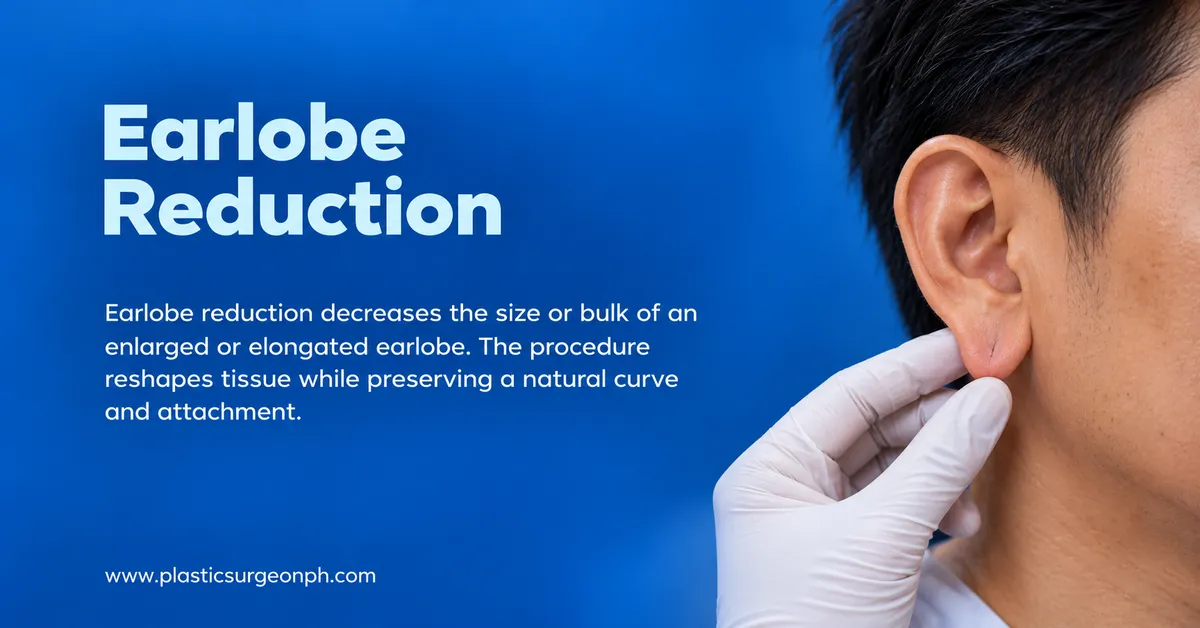
Earlobe Reduction is a highly individualized procedure that decreases the height, width, projection, or bulk of an enlarged or elongated earlobe. Sound planning considers function, facial balance, skin and bone anatomy, healing tendency, and the patient’s own identity. This guide explains the operation in practical language for Philippine patients. It cannot replace an examination or a personalized quotation from the operating team.
What is Earlobe Reduction, and what concerns does it address?
Earlobes may be naturally large, become longer with ageing and heavy jewelry, or appear out of proportion after facelift or ear surgery. Reduction removes tissue while preserving a soft curve and a stable attachment to the cheek. It differs from split-lobe repair because the main issue is overall size or shape rather than a tear, although both concerns can be corrected together.
Wedge excision removes a central or lower segment. Peripheral reduction shortens the free border, while medial designs hide more scar where the lobe joins the cheek. A geometric, triangular, or curved excision may suit different lobe attachments. One-stage repair is common, but major asymmetry or previous scarring may need a tailored flap. A stretched or torn piercing may need earlobe repair before any decision about reducing the size of the lobe. When the whole ear’s shape or position is the concern, otoplasty involves a different operation.
Who is a good candidate for Earlobe Reduction, and who is not?
Good candidates include adults bothered by long, broad, bulky, projecting, or asymmetric lobes who have healthy skin and accept a visible but usually fine scar. They should be in reasonably good health, have stable and specific goals, understand the limitations, and be able to follow recovery instructions. A consultation should explore what the patient hopes will change and what must remain natural or functional.
Surgery should be postponed or reconsidered for patients with active piercing infection, uncontrolled keloid tendency without a management plan, unrealistic requests for an extremely small or attached lobe, compromised blood flow, or ongoing nicotine exposure. Pregnancy, active infection, uncontrolled diabetes or blood pressure, bleeding disorders, and nicotine exposure may also increase risk. A careful surgeon may request treatment, medical clearance, or a period of observation before deciding that an elective operation is appropriate.
What are the different types or techniques used in Earlobe Reduction?
The surgeon measures both ears and plans how much height and width to preserve. A lower wedge can shorten the lobe but risks a rim notch if poorly aligned. A medial or peripheral excision may hide the scar better but changes the attachment or free border. Layered closure prevents edge mismatch and avoids excessive tension that could widen the scar.
The most fashionable technique is not automatically the best one. The correct approach depends on examination findings, prior surgery, tissue quality, desired change, and the surgeon’s ability to protect nearby nerves, vessels, muscles, and sensory structures. Ask why a method suits your anatomy, what trade-offs it creates, and what revision options would remain.
Are there non-surgical alternatives to Earlobe Reduction?
Possible alternatives include lighter earrings and support patches can prevent further stretching, while filler can temporarily strengthen a thin lobe around a piercing, but no non-surgical treatment removes excess lobe skin. Non-surgical treatment is generally temporary or limited in the size of change it can create. It may be sensible for a subtle concern or for someone who is not ready for surgery, but it should not be presented as equivalent when the problem is structural. Injectables also have real risks and require a qualified physician.
How do I prepare for Earlobe Reduction?
Preparation starts with front, side, and rear measurements; scar and keloid history; jewelry and re-piercing plans; comparison with the other ear; and evaluation of any previous facelift scar or reduced blood supply. Give a complete list of prescription medicines, over-the-counter drugs, vitamins, herbal products, allergies, prior procedures, and any reaction to anesthesia. The surgeon may request blood tests, imaging, medical clearance, or specialist review according to the operation and your health.
Stop smoking, vaping, and all nicotine for the period directed because nicotine narrows blood vessels and impairs healing. Do not stop aspirin, anticoagulants, or other prescribed medicines on your own. Follow written instructions on fasting, skin or hair washing, and medicines to take on the day. Arrange an adult escort, safe transport, and help at home. Prepare soft food if advised and keep the recovery space cool, clean, and easy to use.
How is Earlobe Reduction performed, and how long does it take?
With the patient upright, the new outline is marked and compared on both sides. Under local anesthetic, the planned tissue is removed, bleeding is controlled, and the lobe is reconstructed in layers with special attention to the lower rim and cheek attachment. A small protective dressing completes the operation.
Operating time is usually about 30 to 90 minutes for both ears, depending on the design and asymmetry. Complex anatomy, revision surgery, several combined procedures, or the need to reassess symmetry can lengthen this. Time in the facility also includes admission, marking, anesthesia, recovery-room monitoring, and discharge checks, so the entire visit is longer than the operation itself.
What type of anesthesia is used, and who administers it?
Typical options are local anesthesia in most cases, with light sedation only for selected patients or combined facial surgery. The final plan depends on the extent of surgery, age, health, airway, and the facility. Sedation and general anesthesia should be administered and continuously monitored by a qualified anesthesiologist, not by an untrained assistant. Local anesthesia may be placed by the surgeon. Ask who will provide anesthesia, what monitoring will be used, and how emergencies are managed.
What results can I realistically expect, and when will I see them?
The lobe is smaller immediately but swollen and somewhat stiff. Shape is easier to assess after several weeks, and scar softness improves for six to twelve months. Small pre-existing differences between the ears may remain.
The realistic aim is meaningful improvement and better proportion, not perfect symmetry, a copied celebrity feature, or a guaranteed emotional outcome. Photographs are useful for planning and follow-up, but digital simulations are communication tools rather than promises. Final judgement should wait until swelling and scar contraction have settled.
Will I have scars after Earlobe Reduction, and how visible will they be?
The scar may cross the lobe, follow part of its free border, or sit at the cheek attachment. It is permanent and can be visible from some angles, although careful placement and maturation usually make it discreet.
All incisions create permanent scars, even when they become faint. Early scars may be red, raised, numb, itchy, or firm before softening over 6 to 18 months. Scar quality depends on genetics, tension, infection, sun exposure, nicotine, and aftercare. Filipino skin tones can develop dark marks or raised scars, so use only surgeon-approved scar treatment and diligent sun protection.
What are the risks and possible complications of Earlobe Reduction?
General surgical risks include bleeding, hematoma, infection, fluid collection, delayed healing, unfavorable scarring, altered sensation, persistent pain, asymmetry, allergy, anesthetic problems, blood clots, and dissatisfaction. Procedure-specific concerns include bleeding, infection, wound separation, rim notching, unnatural attachment, asymmetry, overreduction, under reduction, altered sensation, suture marks, hypertrophic scar or keloid, and loss of blood supply in heavily scarred tissue. Some complications settle with observation or medicine, while others require an urgent procedure or later revision.
Risk cannot be reduced to zero. It is lowered by honest medical screening, conservative planning, an appropriately trained surgeon, qualified anesthesia care, a licensed facility, and reliable follow-up. Seek urgent help for breathing difficulty, chest pain, sudden vision change, one-sided weakness, rapidly increasing swelling, heavy bleeding, high fever, severe unrelieved pain, or any symptom your team identifies as an emergency.
What is recovery like after Earlobe Reduction, and how long does it take?
Mild swelling, tenderness, and bruising usually settle during the first week. Avoid pressure, snagging, earrings, swimming, and sleeping directly on the ears until the incisions are secure.
Healing is not perfectly linear. One side may swell or settle faster, and sensations can change from day to day. Take only approved medicines, drink enough fluid, eat protein-rich food, avoid nicotine and alcohol as directed, and sleep in the recommended position. Most early healing occurs over two to four weeks, while deeper swelling, nerves, and scars may continue improving for several months.
When can I return to work, exercise, and normal activities?
A reasonable planning estimate is the same day or within one to two days for most patients before returning to work. Normal gentle activity immediately while protecting the wounds is commonly acceptable. Strenuous exercise, heavy lifting, contact sport, and activities that sharply raise blood pressure usually wait one to two weeks, with contact sport and helmets delayed until cleared. These are planning ranges, not clearance. Patients with a physically demanding job, a long commute, public-facing duties, or combined surgery often need more time.
What aftercare and follow-up appointments are required?
Expected follow-up includes a wound check and suture removal at about one week, then scar and symmetry reviews over several months; re-piercing timing is discussed only after maturation. Follow the written instructions for dressings, cleansing, showers, sleeping position, diet, compression, eye or mouth care, and prescribed medicine. Do not massage, apply heat, start scar products, remove tape, or resume supplements without approval. Keep the clinic’s daytime and after-hours contact details and attend reviews even when recovery seems straightforward.
How long do the results of Earlobe Reduction last?
Removed tissue does not regrow, so the reduction is permanent. Ageing, heavy jewelry, trauma, and further stretching can gradually lengthen the remaining lobe.
Long-lasting does not mean frozen in time. Ageing, weight change, sun exposure, illness, trauma, and tissue quality continue to affect the face. Protecting the skin, maintaining stable health, avoiding nicotine, and treating new functional problems early help preserve the result. Revision should be considered only after adequate healing unless there is an urgent complication.
How much does Earlobe Reduction cost in the Philippines, and what is included in the price?
For private care in the Philippines, a cautious planning range is about PHP 30,000 to PHP 110,000 for both ears. This is an indicative 2026 market range, not a quotation, and unusual complexity or a premium hospital can cost more. The main price drivers are the technique, operating time, surgeon and anesthesiologist fees, facility level, implants or grafts, imaging, and whether the procedure is combined with another operation.
Ask for a written itemization and confirm one or both ears, the reduction design, correction of a split or previous scar, keloid prevention, local anesthesia, dressings, and re-piercing. A complete quotation should state consultation, tests, professional fees, operating and recovery rooms, implants or consumables, medicines, garments or dressings, scheduled follow-up, and the policy for unexpected admission or revision. Verify the physician through the PRC and relevant specialist society. For this procedure, consultation with a PAPRAS-qualified plastic surgeon experienced in ear and scar reconstruction is appropriate. Purely cosmetic care is usually self-funded, while a documented functional component may be assessed separately by PhilHealth or a private insurer.
Thank you for sharing this article...
About the Author: Joan de Alta

View Surgeon Profiles




Explore Available Clinics



Browse Other Procedures
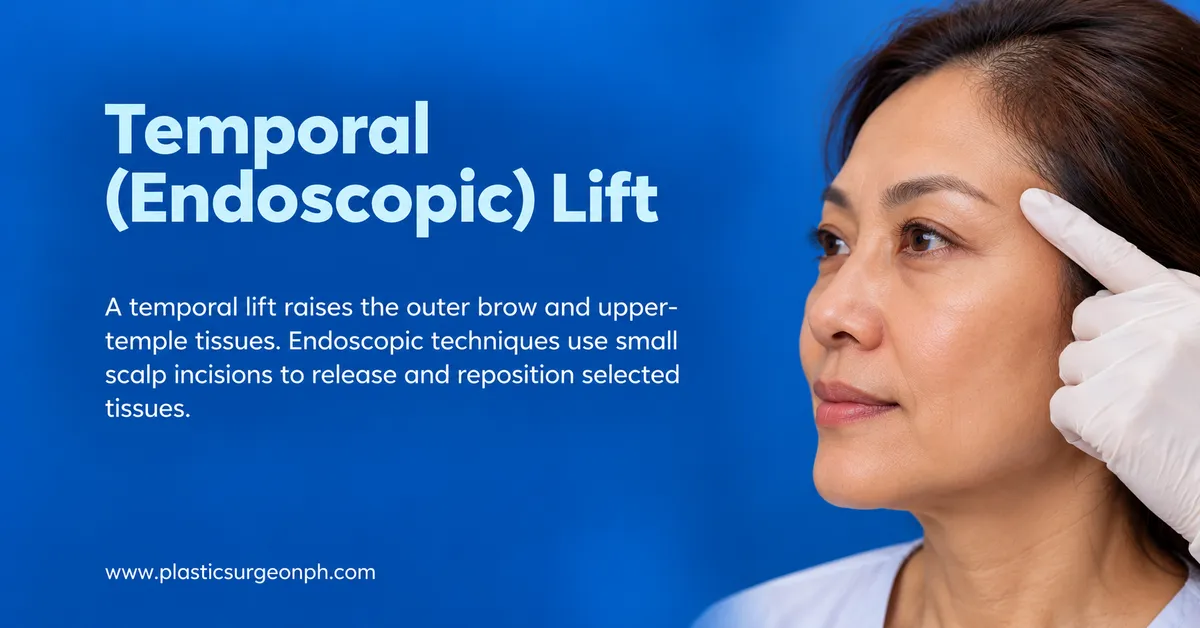
A temporal lift raises the outer brow through incisions near the hairline.