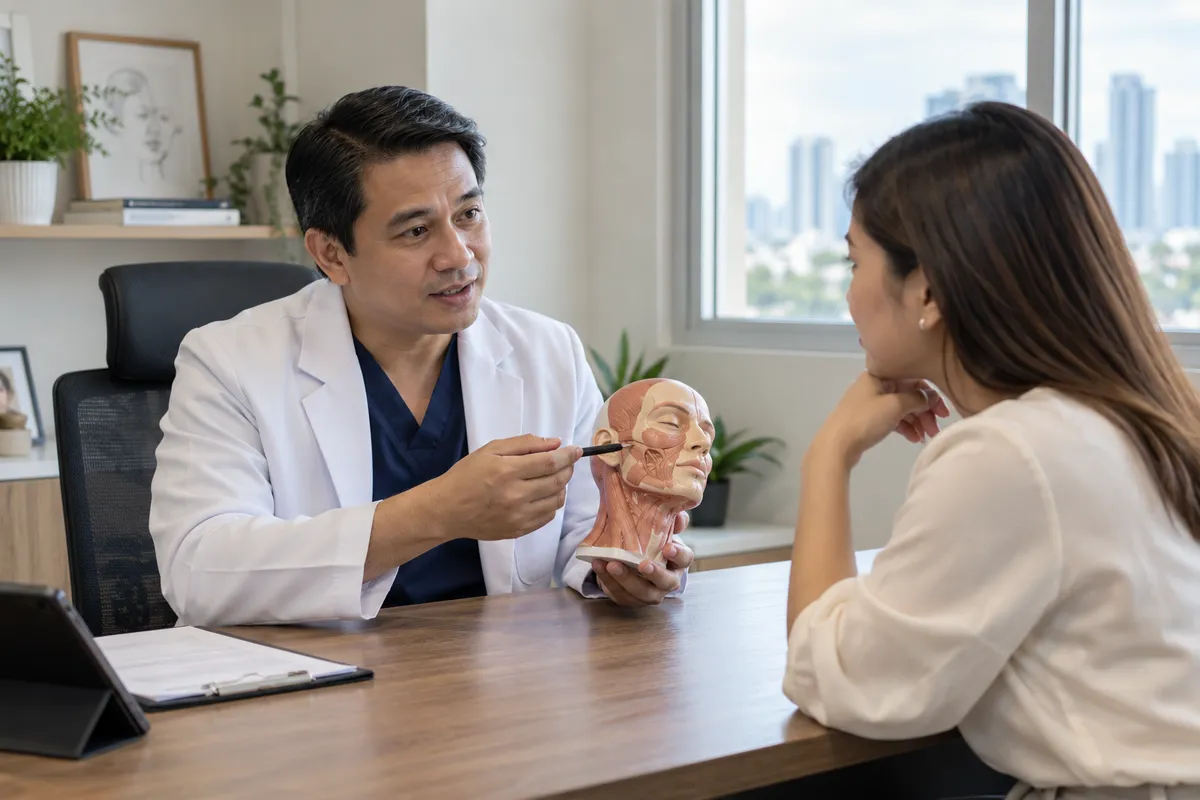
A facelift can improve sagging cheeks, jowls and a poorly defined jawline by repositioning tissues that have descended with age. It is not simply a matter of pulling skin tight. Modern techniques work at deeper levels so the skin can be redraped without an artificial, stretched appearance. The operation can produce a meaningful and durable change, but it cannot stop ageing or correct every wrinkle, pigment change and volume loss on its own.
What is a facelift, and what concerns does it address?
A facelift, medically called rhytidectomy, is surgery that lifts and repositions tissues of the lower face and sometimes the midface and neck. It can improve sagging cheeks, deepened folds beside the mouth, jowls, loose jawline skin and loss of facial contour. Fat may be redistributed or added when ageing has created hollow areas.
A facelift does not primarily treat forehead descent, eyelid bags, skin texture, fine surface lines or pigmentation. Those concerns may require a brow lift, blepharoplasty, laser treatment, chemical peel, skincare or volume restoration. The term also describes several operations of different extent, so patients should ask exactly which anatomical areas and tissue layers a proposed facelift will address.
Who is a good candidate for a facelift, and who is not?
A good candidate has visible lower-face laxity, reasonably elastic skin, stable health, realistic expectations and the ability to follow a substantial recovery plan. The decision is based on anatomy rather than a particular age. Some patients in their forties have meaningful tissue descent, while others much later may still be better suited to less extensive treatment.
Surgery is unsuitable or should be postponed when serious medical conditions are uncontrolled, nicotine use continues, wound-healing risk is excessive or expectations cannot be achieved. Blood pressure must be well managed because postoperative bleeding is an important concern. A patient seeking only treatment for fine lines or mild early laxity may not benefit enough to justify surgery. Facial nerve disorders, previous radiation and extensive prior surgery require specialised evaluation.
What are the different types or techniques used in a facelift?
A traditional facelift uses incisions around the ear and hairline to lift the superficial musculoaponeurotic system, commonly called the SMAS, and redrape skin. SMAS techniques may tighten, fold or reposition this layer. A deep-plane facelift releases selected retaining ligaments and moves deeper cheek and lower-face tissues as a unit. The best method depends on anatomy and surgeon expertise, not a fashionable name.
A limited-incision or mini facelift uses shorter access and suits selected patients with less laxity. A midface lift focuses more on descended cheek tissue, while a lower facelift targets jowls and the jawline. Neck work, fat grafting, blepharoplasty or brow lift may be added for balance. Terms are not standardised across clinics, so the written plan should describe the actual operation.
Are there non-surgical alternatives to a facelift?
Fillers or fat can restore selected volume, while botulinum toxin reduces muscle-related lines. Energy devices using ultrasound, radiofrequency or laser may improve mild skin laxity or texture. Thread lifts provide a modest, temporary lift for carefully selected patients. None of these reliably removes substantial loose skin or repositions heavy jowls to the same degree as surgery.
Non-surgical treatment may be appropriate when ageing changes are early, the patient cannot accept downtime or medical risk is too high. Combining too much filler in a lax face can create heaviness rather than true lifting. A staged plan based on the main cause, tissue descent, volume loss, muscle activity or skin quality, is more rational than choosing a treatment because it is advertised as a facelift alternative.
How do I prepare for a facelift?
Preparation includes medical history, examination of facial movement, skin quality, hairline, scars, previous procedures and photographs. The surgeon should assess the face and neck together. Laboratory tests, electrocardiogram, medical clearance or adjustment of chronic-condition treatment may be required. Blood pressure should be controlled before proceeding.
Stop nicotine for the period ordered by the surgeon because it greatly increases the risk of skin-healing problems. Do not independently stop aspirin, anticoagulants or prescribed medicine. Arrange coordination with the prescribing doctor. Prepare at least two weeks of social downtime, reliable transport, an adult companion and help with meals, pets and household duties. Colouring hair is usually avoided close to surgery and during early incision healing.
How is a facelift performed, and how long does it take?
After anaesthesia, incisions commonly begin in the temple hairline, pass around natural ear contours and continue behind the ear into the hair-bearing scalp. The surgeon elevates tissues, repositions the SMAS or deep plane, redistributes fat if needed, redrapes skin and removes only the excess without excessive tension. A small incision beneath the chin may permit neck fat or muscle treatment.
Fine sutures or clips close the incisions. Temporary drains may be placed, and a gentle dressing is applied. An isolated limited facelift may take two to three hours. A comprehensive facelift commonly takes four to six hours, and combined face, neck, eyelid or fat-grafting procedures can take longer. The duration depends on complexity and should be planned within safe anaesthetic limits.
What type of anesthesia is used, and who administers it?
Many full facelifts are performed under general anaesthesia. Some limited or carefully selected procedures use local anaesthesia with intravenous sedation. The choice depends on the depth and length of surgery, patient health, airway, comfort and facility resources.
A qualified anaesthesiologist should evaluate the patient and administer deep sedation or general anaesthesia while continuously monitoring vital signs. Ask who will provide anaesthesia, whether a separate professional fee applies and what facility is being used. A major facelift should be performed in a hospital or appropriately licensed surgical facility with emergency equipment and trained recovery staff.
What results can I realistically expect, and when will I see them?
A well-planned facelift can create smoother cheek contours, less prominent jowls and a cleaner jawline while retaining natural expression. It does not make a person look like somebody else, remove every fold or freeze ageing. Mild asymmetry will remain, and areas not included in the operation will continue to show their existing characteristics.
Improvement becomes visible as bruising and swelling settle over two to four weeks. The face may initially feel tight, firm or unfamiliar. Deeper swelling and tissue firmness gradually improve for several months, and scars continue to mature for six to twelve months or longer. Patients should judge the result in consistent lighting rather than through filtered photographs.
Will I have scars after a facelift, and how visible will they be?
Facelift scars usually follow the hairline and the natural contours in front of, within and behind the ear. A neck component may add a short scar beneath the chin. Placement varies according to sex, hairstyle, hairline, sideburn position and technique. Good planning avoids obvious hairline distortion and preserves natural ear shape.
Scars are initially pink, firm or darker and normally fade over time. They can widen, thicken, become pigmented or cause local hair loss. Nicotine, infection, tension and poor sun protection worsen healing. Hairstyles may temporarily help during maturation, but patients should never be promised an invisible or scarless facelift.
What are the risks and possible complications of a facelift?
Possible complications include bleeding or haematoma, infection, fluid collection, anaesthetic problems, blood clots, prolonged swelling, pain, numbness, asymmetry, contour irregularity, poor scarring and dissatisfaction. A haematoma can threaten skin and often requires urgent drainage. Uncontrolled hypertension and certain medicines increase bleeding risk.
Facial nerve injury can cause temporary or, rarely, permanent weakness. Skin loss and delayed healing are more likely with nicotine exposure. Hair loss can occur near incisions, and scars or earlobes can become distorted. Seek urgent care for rapidly increasing one-sided swelling, severe pain, breathing difficulty, facial weakness, fever, drainage, darkening skin, chest pain or calf swelling.
What is recovery like after a facelift, and how long does it take?
Bandages and drains may be used during the first day or several days. Swelling, bruising, tightness and numbness are expected. Discomfort is often manageable, but sudden severe pain or swelling is not normal. Sleep elevated, keep the head in a neutral position and follow precise instructions for washing and incision care.
Many patients feel considerably better after the first week and are socially presentable in two to three weeks. Residual swelling, firmness, numbness and a pulling sensation can persist for months. Recovery is longer when neck lift, eyelid surgery, fat grafting or resurfacing is added. Emotional fluctuations are common while appearance changes daily.
When can I return to work, exercise, and normal activities?
Desk-based work often resumes after about two weeks, although three weeks may be more comfortable for public-facing roles. Physically demanding work requires more time. Gentle walking begins early to support circulation, but bending, straining and lifting are restricted because they can raise blood pressure and bleeding risk.
Exercise usually resumes in stages over four to six weeks with surgeon clearance. Hair colouring, salon treatments, earrings, skincare devices, swimming and dental work may require specific timing. Driving is unsafe while taking sedating medicine or when neck movement is limited. Protect healing tissues from accidental pressure and sun.
What aftercare and follow-up appointments are required?
Aftercare includes prescribed medicines, drain recording if applicable, incision cleaning, head elevation and activity restrictions. Do not apply ice or heat unless the surgeon specifically directs it because temperature injury can harm numb skin. Avoid nicotine completely and keep blood pressure controlled. Use compression only in the manner prescribed, since excessive pressure can damage tissue.
Early visits monitor bleeding, skin circulation, drains and wounds. Sutures or clips are removed according to location and healing. Later reviews assess scars, symmetry, nerve function and swelling. Promptly report sudden swelling, severe pain, fever, drainage, dusky skin, shortness of breath, chest pain or leg swelling.
How long do the results of a facelift last?
A facelift turns back visible ageing but does not stop the ageing process. Many patients retain a meaningful improvement for seven to twelve years, sometimes longer, depending on technique, skin quality, genetics, weight stability, sun exposure and nicotine use. Even years later, the person generally looks better than if the operation had never been performed.
Stable weight, daily sun protection and healthy habits support longevity. Non-surgical treatments may maintain skin quality or volume, but they should be selected conservatively. A secondary facelift may be considered later, provided health and tissue quality remain suitable.
How much does a facelift cost in the Philippines, and what is included in the price?
Current public Philippine prices show a broad range. Limited or traditional procedures may be advertised around PHP 100,000 to PHP 200,000, while hospital-based comprehensive or deep-plane facelifts may cost about PHP 250,000 to PHP 400,000 or more. A current Manila source lists uncomplicated deep-plane facelift estimates at PHP 350,000 to PHP 400,000, excluding some tests, medicines and variable facility fees.
Request an itemised quote covering the surgeon, anaesthesiologist, operating room, admission, medicines, garments, drains, tests, medical clearance and follow-up. Confirm whether neck lifting, fat grafting, eyelid surgery or brow work is included or separately charged. Do not compare a mini facelift price with a full face and neck operation as if they are the same service.
Thank you for sharing this article...
About the Author: Randy Alta