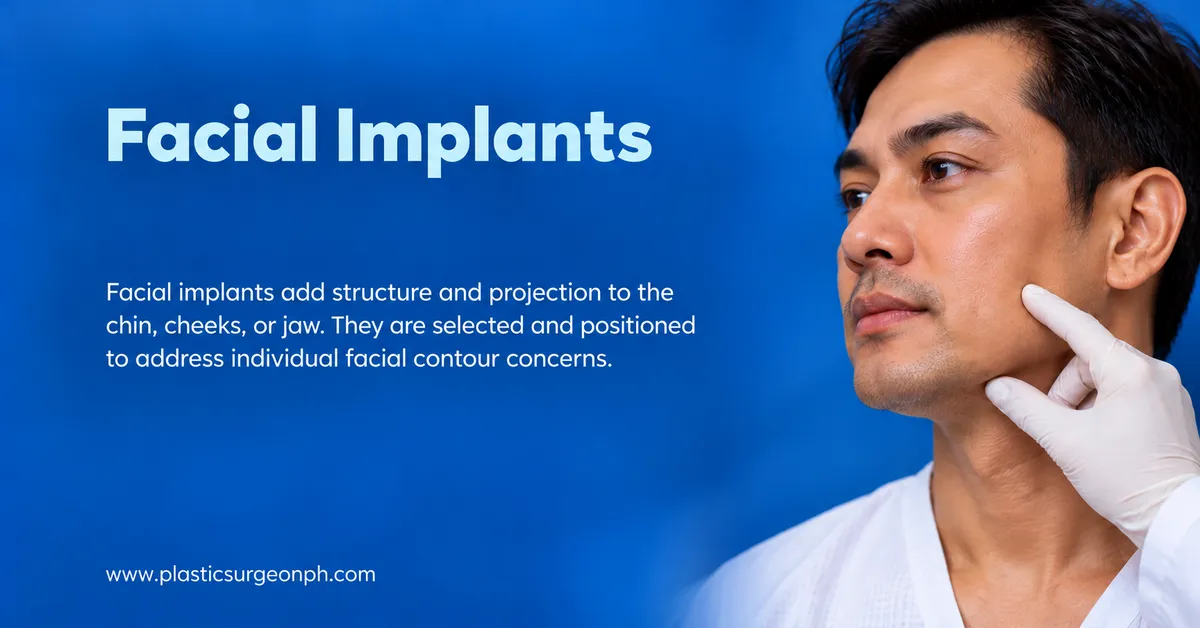
Facial implants add permanent structural projection to areas such as the chin, cheeks or jaw angles. They can improve skeletal balance more predictably than soft filler when a substantial, stable change is needed. However, an implant is a foreign material and can move, become infected or affect underlying bone. Appropriate sizing and precise placement are more important than choosing the largest possible implant.
What are facial implants, and what concerns do they address?
Facial implants are solid, biocompatible devices shaped to sit on facial bone. Chin implants improve projection, cheek or malar implants increase midface prominence, submalar implants address selected cheek hollowing and jaw-angle implants add lower-face width or definition. Custom devices can correct complex asymmetry or reconstructive defects.
Implants improve skeletal contour but do not tighten loose skin, correct a bite problem or stop ageing. A cheek implant is not equivalent to a facelift, and a jaw implant cannot substitute for orthognathic surgery when the teeth and jaws are misaligned. The surgeon must assess the whole face so added projection does not create imbalance. For example, cheek (malar) augmentation focuses on projection in the midface rather than the chin or jaw. When the desired change is limited to chin projection, chin augmentation can be discussed more specifically.
Who is a good candidate for facial implants, and who is not?
Good candidates have completed facial growth, a stable skeletal deficiency or asymmetry, healthy soft-tissue coverage, realistic expectations and acceptable surgical health. They should understand the difference between fixed implant projection and softer volume from filler or fat. Dental health is particularly important for implants inserted through the mouth.
Active oral, sinus or skin infection, uncontrolled illness, poor healing risk and nicotine use require delay. Very thin or previously damaged tissues may not safely cover a large implant. Significant bite problems, untreated facial pain or progressive skeletal disease need specialist assessment. Patients seeking extreme changes or frequent implant swaps may face escalating scar and complication risk.
What are the different types or techniques used in facial implants?
Common materials include solid silicone and porous polyethylene. Silicone is relatively easy to insert and remove, while porous material permits tissue ingrowth and can be more difficult to remove. Other materials and custom three-dimensional printed devices may be used according to availability and regulatory approval. Shapes include malar, submalar, combined cheek, chin, prejowl and jaw-angle designs.
Implants are placed through incisions beneath the chin, inside the mouth, within the lower eyelid or near the hairline, depending on location. A pocket is created directly over bone, the device is centred and it may be secured with screws. Custom planning can improve fit in asymmetric or reconstructive cases but adds imaging, manufacturing time and cost.
Are there non-surgical alternatives to facial implants?
Hyaluronic acid filler can temporarily add chin, cheek or jaw contour and may preview a modest change. Biostimulatory injectables and fat grafting provide softer volume but are less precise for sharp skeletal definition. Results and reversibility vary by product.
Sliding genioplasty moves the patient’s chin bone, while orthognathic surgery moves the jaws and corrects the bite. Cheekbone or jaw reduction treats excessive width rather than deficiency. A facelift addresses descended tissue. The best alternative depends on whether the concern is bone position, soft-tissue volume or laxity.
How do I prepare for facial implants?
Preparation includes facial-proportion analysis, photographs, dental and bite assessment and sometimes three-dimensional imaging. The surgeon should discuss implant material, dimensions, brand, regulatory status, incision and fixation. Disclose all fillers, threads, dental implants, infections, sinus disease and previous facial surgery.
Stop nicotine as directed and coordinate all medicine changes with the prescribing physician. Treat oral, dental, sinus or skin infection before surgery. Complete tests and medical clearance. Arrange transport, an adult companion, soft food for intraoral procedures and enough leave for swelling. Understand how an implant could be removed or revised if complications occur.
How are facial implants placed, and how long does the procedure take?
After anaesthesia, the surgeon reaches the bone through the planned incision and creates a precise pocket. The implant is inserted without contamination, checked for symmetry and sometimes fixed with screws. Intraoral incisions are closed with dissolvable sutures, while skin incisions use fine sutures or adhesive. Dressings or compression may support the area.
A single chin or cheek area may take one to two hours. Bilateral jaw angles, multiple regions or custom reconstruction commonly take two to four hours or longer. Most cosmetic cases are outpatient, but extensive jaw implants or combined operations may justify observation.
What type of anesthesia is used, and who administers it?
A single small implant may be placed under local anaesthesia with sedation. Cheek, jaw, multiple or custom implants are commonly performed under general anaesthesia. The location, duration and intraoral access influence the choice.
The surgeon injects local anaesthetic. A qualified anaesthesiologist should administer deep sedation or general anaesthesia and monitor the patient. Ask whether the facility is licensed for the planned anaesthesia and whether overnight observation, if needed, is included in the quotation.
What results can I realistically expect, and when will I see them?
Facial implants provide a defined, stable increase in projection or width. They can improve balance but cannot guarantee exact symmetry. Soft tissue can make the same implant appear different on each side, and the face changes during expression. Choosing an appropriate size is more important than pursuing a dramatic result.
The change is immediate but initially exaggerated by swelling. Most visible swelling improves over two to four weeks, while jaw-angle and multiple implants may take longer. The implant pocket and overlying tissue settle over two to three months. Residual numbness or firmness can take several months to improve.
Will I have scars after facial implants, and how visible will they be?
Intraoral placement leaves no external skin scar. Chin implants may use a short crease scar beneath the chin. Cheek implants can be inserted through the mouth or a lower-eyelid route, while jaw implants usually use intraoral incisions. Custom reconstructive cases may require other access.
Internal scars can still become tight, infected or palpable. External scars may darken, widen or thicken. Incision choice balances scar location with contamination, exposure and implant control. Follow wound care and sun protection, and do not massage implants without approval.
What are the risks and possible complications of facial implants?
Risks include bleeding, haematoma, infection, anaesthetic reaction, pain, swelling, numbness, scarring, asymmetry and dissatisfaction. Implants can shift, rotate, become palpable, show through thin tissue, extrude or develop firmness around them. Infection may require complete removal and delayed replacement.
Underlying bone may erode or remodel. Nerve injury can affect sensation or facial movement. Intraoral wounds can open, and jaw implants can affect chewing muscles temporarily. Custom devices do not eliminate risk. Seek prompt care for fever, worsening pain, pus, wound opening, exposed material, sudden asymmetry, new weakness or progressive numbness.
What is recovery like after facial implants, and how long does it take?
Expect swelling, bruising, pressure, tightness and temporary numbness. Intraoral procedures may require liquid or soft food and antiseptic rinse. Jaw-angle implants can cause more pronounced swelling and chewing discomfort. Sleep elevated and avoid direct pressure on the treated region.
Many patients are socially presentable in one to three weeks, depending on implant location and number. Deeper swelling and firmness continue for several months. Do not repeatedly press the implant or compare daily photographs, as swelling is rarely identical on both sides.
When can I return to work, exercise, and normal activities?
Desk work often resumes after one to two weeks. Jaw implants or multiple regions may require two to three weeks. Gentle walking begins early, while strenuous exercise is commonly restricted for three to six weeks depending on fixation and swelling.
Avoid contact sport and pressure from helmets, masks or sleep until the surgeon confirms stability. Dental work may be postponed after intraoral placement. Driving waits until sedating medicine is stopped. Return to hard chewing, shaving, makeup and facial treatments should be gradual and approved.
What aftercare and follow-up appointments are required?
Aftercare may include incision cleaning, prescribed medicines, mouth rinse, soft diet and a support garment. Maintain oral hygiene without traumatising the wound. Never adjust, massage or push an implant unless instructed. Report dental or sinus infection even months later because bacteria can threaten an implant.
Early visits check position, nerve function, wounds and infection. Later follow-up assesses settling, bone response and symmetry. Contact the team urgently for fever, increasing pain, pus, wound separation, exposed implant, sudden movement or facial weakness.
How long do the results of facial implants last?
Facial implants are intended to be permanent, but they are removable and may require revision. Late infection, movement, bone change, trauma, ageing or changing preferences can lead to removal or replacement. Routine replacement is not automatically required for every solid implant.
Good dental and skin health, avoidance of trauma and prompt treatment of infection support longevity. The soft tissue surrounding an unchanged implant still ages, so future lifting or volume treatment may be considered without necessarily replacing the device.
How much do facial implants cost in the Philippines, and what is included in the price?
Published estimates place facial implants in the Philippines around PHP 80,000 to PHP 200,000 or more per region. Public local cheek augmentation packages range roughly from PHP 80,000 to PHP 120,000, while custom implants, bilateral jaw angles, three-dimensional planning and hospital anaesthesia can cost substantially more. Chin-only pricing may begin lower.
The written quote should state the implant location, one or both sides, material, brand, custom design, fixation screws, surgeon, anaesthesiologist, facility, imaging, tests, medicines and follow-ups. Ask who pays for removal or replacement if infection or malposition develops. Filler and fat-grafting prices are not valid comparisons with permanent implant surgery.
Thank you for sharing this article...
About the Author: Joan de Alta