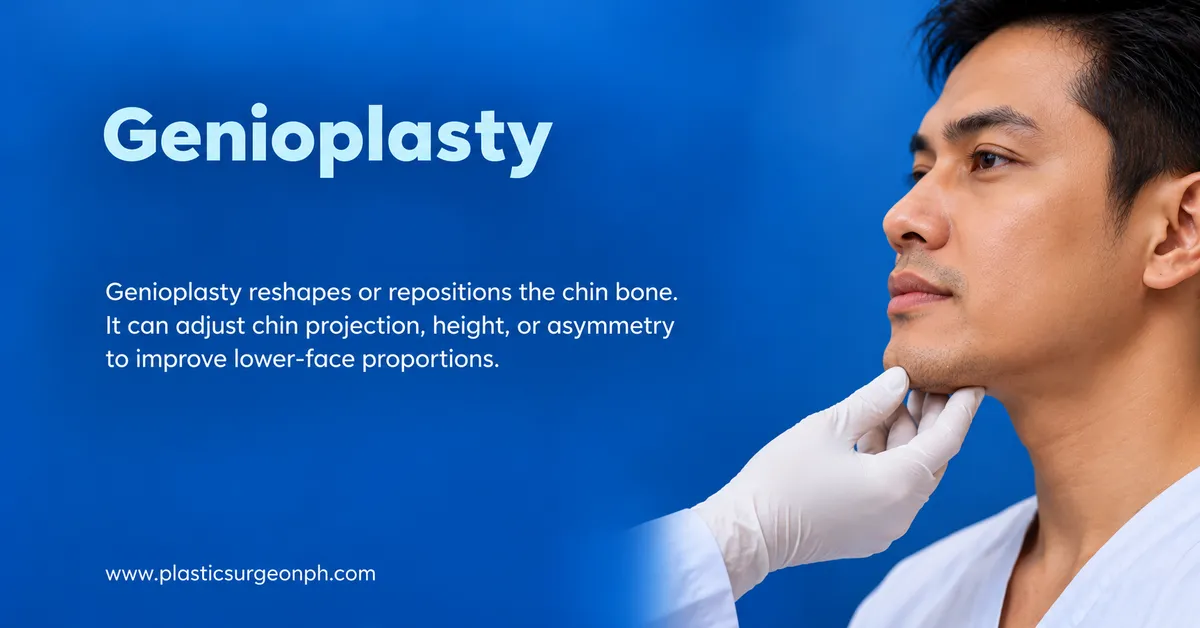
Genioplasty reshapes or repositions the chin bone. Although some clinics use the word for any chin enhancement, a sliding or osseous genioplasty is different from placing an implant. It can move the patient’s own bone forward, backward, upward, downward or sideways, making it more versatile for complex proportion and asymmetry. Because bone is cut and fixed, recovery and risk are greater than with a simple implant.
What is genioplasty, and what concerns does it address?
Genioplasty is surgery that changes the shape or position of the bony chin. It can improve a recessed, overly prominent, long, short, narrow, wide or asymmetric chin. Forward movement may improve lower-face balance and, in selected cases, contribute to airway planning, but genioplasty alone does not correct the position of the teeth or entire lower jaw.
The operation may be cosmetic, reconstructive or part of corrective jaw surgery. It is important to distinguish isolated chin deficiency from mandibular deficiency. A patient with significant bite problems may need orthognathic surgery, not cosmetic chin movement alone. The treatment plan should be coordinated with orthodontic or maxillofacial care when occlusion is abnormal. When the bite or jaw relationship also needs correction, orthognathic (corrective jaw) surgery has a different scope from moving the chin alone. The chin implant and genioplasty comparison explains useful questions about changing chin projection with an implant or bone surgery.
Who is a good candidate for genioplasty, and who is not?
Good candidates have completed facial growth, a chin-bone concern that requires movement or reshaping, suitable dental and bone health, stable general health and realistic expectations. It is particularly useful when an implant cannot provide enough vertical change, centralise an asymmetric chin or avoid excessive foreign material.
Active dental infection, uncontrolled illness, nicotine use, poor bone healing risk or unrealistic expectations require delay or reconsideration. Patients with an untreated bite discrepancy should not use genioplasty merely to camouflage a jaw problem without specialist assessment. Severe sleep apnoea or craniofacial conditions require comprehensive airway and skeletal planning rather than an isolated cosmetic approach.
What are the different types or techniques used in genioplasty?
In sliding genioplasty, the surgeon cuts the lower part of the chin bone, moves it to the planned position and secures it with titanium plates and screws. The segment can move forward, backward, upward, downward or sideways. Bone wedges or grafts may change height and symmetry. Reduction genioplasty removes or contours excess bone.
Three-dimensional planning and patient-specific guides can improve accuracy for complex movements. Genioplasty may be performed alone or with upper or lower jaw surgery. An implant is technically another form of chin augmentation but should be described separately because it adds material without moving the native bone.
Are there non-surgical alternatives to genioplasty?
Filler can temporarily improve mild projection or contour and may help a patient visualise a small change. Fat grafting adds soft volume but cannot move bone. A chin implant provides permanent projection without an osteotomy and usually has an easier recovery, but it is less versatile for large vertical or asymmetric corrections.
Orthodontics can improve tooth alignment but does not by itself reposition an adult chin. Orthognathic surgery is the correct alternative when the whole jaw and bite require movement. The choice should be based on skeletal diagnosis, not on which procedure seems least expensive.
How do I prepare for genioplasty?
Preparation includes facial and dental examination, bite assessment, photographs and usually radiographs or three-dimensional imaging. The surgeon plans the bone cut in relation to tooth roots, mental nerves and lower-jaw border. Dental infection must be treated, and orthodontic input may be required. Medical tests and clearance depend on health and anaesthesia.
Stop nicotine for the specified period and coordinate all medicine changes with the prescribing doctor. Arrange transport, an adult companion, soft or blended food and adequate leave. Understand the possibility of prolonged chin and lower-lip numbness. Maintain excellent oral hygiene before surgery without injuring the gums.
How is genioplasty performed, and how long does it take?
The usual incision is inside the lower lip, so the chin bone is reached without a skin incision. The surgeon protects the mental nerves, uses a saw to make a controlled osteotomy, moves the segment according to the plan and secures it with plates and screws. Bone edges are smoothed, bleeding is controlled and the gum is closed with dissolvable sutures.
An isolated genioplasty generally takes one to two hours, while complex asymmetry, bone grafting or combined jaw surgery takes longer. A supportive external dressing may be applied. Some patients go home the same day, while others stay overnight based on swelling, anaesthesia and associated procedures.
What type of anesthesia is used, and who administers it?
Sliding genioplasty is usually performed under general anaesthesia. This allows precise bone surgery while protecting the airway and keeping the patient still. Local anaesthetic is also injected to reduce pain and bleeding.
A qualified anaesthesiologist should conduct the preoperative assessment, administer general anaesthesia and monitor the patient throughout and into recovery. Discuss previous anaesthetic reactions, sleep apnoea, asthma, allergies and all medicines. The procedure should take place in a suitably licensed and equipped surgical facility.
What results can I realistically expect, and when will I see them?
Genioplasty can produce a substantial and precise improvement in projection, height or alignment. It cannot guarantee perfect symmetry, and soft tissues do not always follow bone movement exactly. If the entire jaw is deficient, the profile may improve while the bite problem remains unless jaw surgery is also performed.
The change is visible immediately but obscured by swelling. Much of the swelling improves over two to six weeks. Bone healing takes several weeks, while final soft-tissue settling and nerve recovery can continue for three to six months or longer. Three-dimensional changes should be judged from consistent photographs and clinical examination.
Will I have scars after genioplasty, and how visible will they be?
The standard sliding genioplasty incision is inside the lower lip, so there is no external skin scar. The internal gum scar normally becomes unobtrusive. An external scar may be present if the operation is combined with another procedure or if a different approach is clinically required.
Internal scarring can occasionally tether the lower lip or change the chin crease. Plates and screws remain beneath tissue and are not visible, although they may rarely become palpable or require removal. Good oral care reduces infection and wound breakdown.
What are the risks and possible complications of genioplasty?
Risks include bleeding, infection, anaesthetic reaction, pain, swelling, asymmetry, poor bone healing, relapse and dissatisfaction. Mental nerve irritation can cause numbness, tingling or altered sensation of the chin and lower lip. This is often temporary but can be permanent. Tooth-root injury is possible if the bone cut is too close.
Other complications include plate or screw problems, bone-segment movement, contour steps, lower-lip weakness, chin dimpling, gum recession and need for revision. Rarely, the bone may fail to unite. Seek urgent care for increasing swelling, fever, pus, wound opening, uncontrolled bleeding, breathing difficulty or new severe pain.
What is recovery like after genioplasty, and how long does it take?
Expect swelling, bruising, pressure, drooling and lower-lip or chin numbness. Swelling often peaks during the first few days. A soft or liquid diet and antiseptic mouth rinse may be prescribed. Keep the head elevated and avoid pulling the lower lip to inspect the incision repeatedly.
Many patients are socially presentable after two to three weeks, although swelling and numbness last longer. Dissolvable sutures may take two weeks or more to disappear. Initial bone union develops over about six weeks, with continued remodelling for months. Follow dietary and activity restrictions until the surgeon confirms stability.
When can I return to work, exercise, and normal activities?
Desk work may resume in one to two weeks, depending on swelling, speech and comfort. More visible or physically demanding roles may require two to three weeks. Gentle walking begins early, but heavy lifting and strenuous exercise are usually restricted for four to six weeks.
Contact sports and any risk of a blow to the chin are avoided for several months or until bone healing is confirmed. Dental work, hard chewing and orthodontic adjustments follow the surgical team’s schedule. Driving waits until sedating medicine is stopped and movement and concentration are normal.
What aftercare and follow-up appointments are required?
Aftercare includes prescribed pain medicine, oral rinses, gentle tooth cleaning, a soft diet, head elevation and care of the external support dressing. Take antibiotics only as prescribed and complete the course if one is given. Do not smoke or vape, as nicotine can compromise bone and wound healing.
Follow-up checks the wound, nerve function, bite, bone position and hardware. Imaging may be used when indicated. Report fever, pus, increasing pain, wound opening, bad taste, sudden asymmetry, loose hardware sensation or breathing difficulty promptly.
How long do the results of genioplasty last?
Once the bone heals in its new position, the skeletal change is intended to be permanent. Normal ageing and soft-tissue changes continue, and major trauma or uncommon relapse can alter the result. Titanium plates and screws often remain indefinitely unless they cause a problem.
Stable weight, good dental health and protection from trauma support longevity. If hardware removal becomes necessary after healing, removing it does not normally reverse the bone movement. Revision is possible but requires new assessment and imaging.
How much does genioplasty cost in the Philippines, and what is included in the price?
Private cosmetic sliding genioplasty may cost approximately PHP 150,000 to PHP 350,000 or more in the Philippines, depending on imaging, planning, hospital, hardware, movement complexity and whether jaw surgery is combined. Public listings for jaw contouring start around PHP 150,000, while current PhilHealth case rates for medically indicated procedures are reimbursement schedules, not full cosmetic market prices or guaranteed patient charges.
Request an itemised quotation for the surgeon or maxillofacial team, anaesthesiologist, hospital, plates and screws, imaging, laboratory tests, medical and dental clearance, medicines, admission and follow-up. Confirm whether orthodontics, jaw surgery, hardware removal and treatment of complications are separate. An implant price should never be presented as if it were the price of sliding bone surgery.
Thank you for sharing this article...
About the Author: Joan de Alta