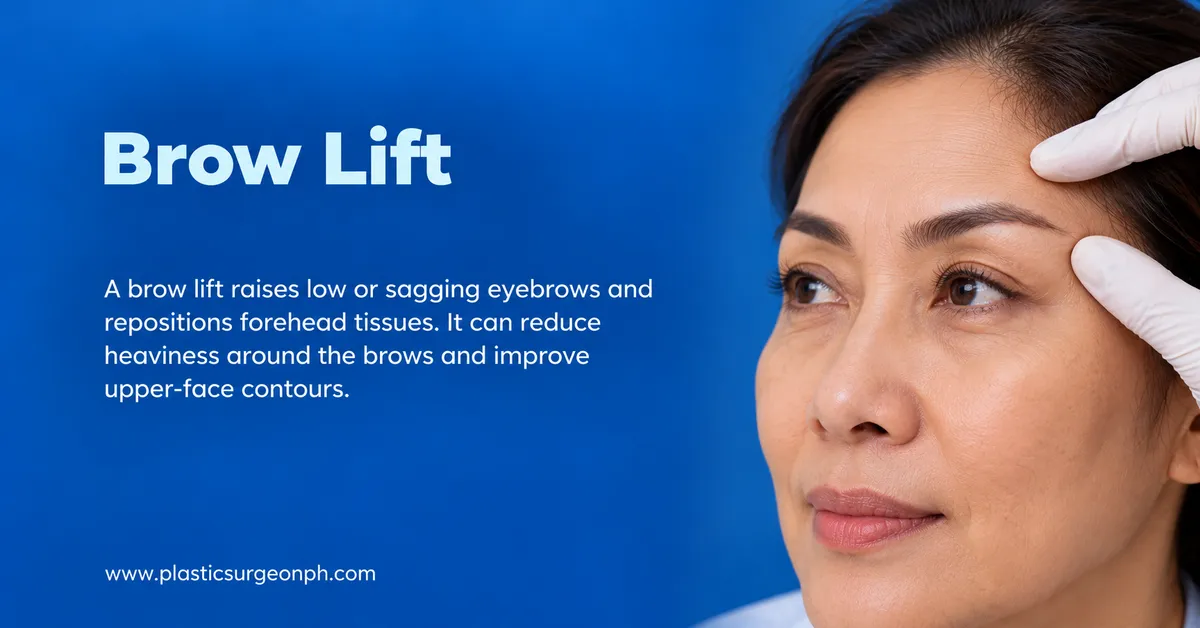
A brow lift raises descended eyebrows and repositions forehead tissue. It can make the eyes look more open and soften a tired or stern expression, but it should not create an unnaturally high or surprised brow. The correct lift depends on brow shape, hairline, forehead height, sex, eyelid skin and muscle activity. In some patients, the apparent eyelid problem is actually caused by brow descent.
What is a brow lift, and what concerns does it address?
A brow lift, also called a forehead lift, elevates low or sagging eyebrows and may soften horizontal forehead lines and vertical frown lines. It can improve heaviness over the outer eyelid, brow asymmetry and an angry or tired appearance caused by tissue descent. It does not directly remove upper-eyelid skin or lower-eyelid bags.
Some patients need a brow lift alone, while others need blepharoplasty or both. The surgeon should manually raise the brow during examination to see how much apparent eyelid excess changes. Muscle-related wrinkles may remain and later require botulinum toxin. Skin texture and pigmentation need separate treatment. When the change is mainly at the outer brow, temporal (endoscopic) lift may be discussed instead of a full forehead lift.
Who is a good candidate for a brow lift, and who is not?
Good candidates have clinically low brows, forehead laxity or asymmetry, realistic expectations and suitable health. Hairline position, hair density and hairstyle matter because they influence technique and scar concealment. Both women and men can benefit, but male brow shape is usually lower and flatter, so over-elevation can look unnatural.
Surgery may be inappropriate for mild dynamic lines without true descent, uncontrolled medical conditions, active scalp disease, continued nicotine use or unrealistic expectations. People with significant hair loss, a very high forehead or previous scalp surgery need modified planning. A patient who actually has ptosis or isolated eyelid skin excess requires the correct diagnosis rather than a brow lift by default.
What are the different types or techniques used in a brow lift?
An endoscopic brow lift uses several small scalp incisions and a camera to release and reposition tissue. A coronal lift uses a longer incision within hair-bearing scalp and can lift the full forehead, but it may raise the hairline. A pretrichial or hairline lift places the incision at the front hairline and can avoid further forehead lengthening or lower a high hairline.
A temporal lift focuses on the outer brow through shorter temple incisions. A direct brow lift removes skin just above the eyebrow and offers precise control, but the scar is more visible. A transblepharoplasty browpexy supports the brow through an upper-eyelid incision and provides a modest lift. Fixation may use sutures, screws or absorbable devices depending on technique.
Are there non-surgical alternatives to a brow lift?
Botulinum toxin can weaken muscles that pull the brow down and create a small temporary chemical brow lift. It also softens frown and forehead lines, but poor dosing can lower the brow or eyelid. Filler may support selected temple or brow hollows. Energy devices and threads may produce modest temporary tightening.
These options suit early descent or patients avoiding surgery, but they cannot reliably reposition substantial forehead tissue. Upper blepharoplasty is not an alternative when the brow itself is low, and removing too much eyelid skin may worsen the imbalance. A proper examination should separate brow position, eyelid skin and true ptosis.
How do I prepare for a brow lift?
The surgeon assesses facial expression, brow height and shape, eyelid skin, forehead length, hairline, scalp laxity and hair-loss pattern. Photographs are taken at rest and during movement. Discuss previous botulinum toxin, fillers, hair transplant, scalp surgery and eye procedures. Medical tests and clearance depend on age, health and anaesthesia.
Stop nicotine as directed and coordinate medicine changes with the prescribing physician. Avoid hair colouring close to surgery because the scalp incision needs time to heal before chemical exposure. Arrange transport, an adult companion and recovery leave. Prepare to sleep elevated and avoid hairstyles that pull on the incisions. For consultation contacts and listed services, review the Zi Institute profile and confirm the proposed procedure and facility directly with the clinic.
How is a brow lift performed, and how long does it take?
After anaesthesia, incisions are made according to the selected technique. The surgeon releases attachments that hold descended tissue, adjusts selected frown muscles if appropriate, raises the brow and secures it in a new position. Excess skin may be removed in coronal, hairline or direct techniques. Incisions close with sutures, clips or adhesive.
An isolated brow lift commonly takes one to two hours. Direct or limited temporal work may be shorter, while combined eyelid or facelift surgery takes longer. A dressing may be placed, and a drain is occasionally used. The operation is usually outpatient.
What type of anesthesia is used, and who administers it?
Direct and limited brow lifts may be performed under local anaesthesia with or without light sedation. Endoscopic, coronal and combined procedures often use intravenous sedation or general anaesthesia. Patient comfort, procedure length and medical status guide the choice.
The surgeon can inject local anaesthetic. A qualified anaesthesiologist should manage deep sedation or general anaesthesia and monitor the patient continuously. Ask about the provider’s credentials, monitoring, facility licence and arrangements for recovery or unplanned admission.
What results can I realistically expect, and when will I see them?
The goal is a better-positioned brow, reduced heaviness and a more rested expression, not elimination of every forehead line. Natural asymmetry and muscle activity remain. An appropriate result respects sex, ethnicity, eye shape and baseline brow pattern instead of imposing one fashionable arch.
The lift is visible immediately but may look too high or uneven while swelling and fixation settle. Bruising often improves over ten to fourteen days. Brow position becomes more natural over several weeks, and final scars, sensation and contour may take several months to mature.
Will I have scars after a brow lift, and how visible will they be?
Endoscopic and temporal scars are hidden within the hair. A coronal scar also lies in hair-bearing scalp but is longer. A hairline scar follows the front hairline, while a direct scar lies immediately above the eyebrow. Scar visibility therefore depends strongly on technique and hair density.
Possible issues include widening, pigmentation, thickening and temporary or permanent hair loss near the incision. A hairline can shift upward or change shape. Tell the surgeon about personal or family hair loss and raised scars. Follow sun protection and scar-care instructions only after the wounds have closed.
What are the risks and possible complications of a brow lift?
Risks include bleeding, infection, anaesthetic complications, fluid collection, pain, numbness, itching, asymmetry, poor scarring and need for revision. Hairline elevation or hair loss can occur. Eye dryness or irritation may temporarily worsen when brow and eyelid relationships change.
Injury to facial nerve branches can cause forehead or brow weakness, usually temporary but rarely permanent. Overcorrection, undercorrection or a surprised appearance may occur. Some patients experience prolonged scalp numbness. Seek urgent review for rapidly increasing swelling, severe pain, fever, drainage, facial weakness, vision change or darkening skin.
What is recovery like after a brow lift, and how long does it take?
Expect forehead and scalp swelling, bruising around the eyes, tightness, numbness and itching. The head may be loosely wrapped, and clips or sutures remain until removal. Sleep elevated and keep incisions clean. Do not apply heat or ice unless the surgeon instructs it because numb scalp skin can be injured.
Initial wound healing generally takes ten to fourteen days. Many patients are socially presentable within that period, although swelling and altered sensation continue longer. Scalp numbness, tingling and firmness may take several months to improve.
When can I return to work, exercise, and normal activities?
Office work often resumes after seven to fourteen days, depending on bruising and hairstyle. Gentle walking begins early. Heavy lifting, bending and strenuous exercise are usually restricted for two to four weeks or longer when combined surgery is performed.
Hair washing follows the surgeon’s schedule, while colouring, chemical treatments and tight hairstyles wait until the incisions are secure. Avoid helmets, caps or equipment that press on fixation points. Driving waits until vision is clear and sedating medicine is no longer required.
What aftercare and follow-up appointments are required?
Aftercare includes head elevation, incision cleaning, prescribed medicines and monitoring for bleeding or nerve changes. Do not scratch numb areas or pull on clips and sutures. Use gentle shampoo only when allowed. Protect exposed scars from sunlight.
Follow-up within the first week assesses swelling and wounds, followed by suture or clip removal at the appropriate time. Later reviews monitor brow level, hair growth, sensation and scars. Report worsening one-sided swelling, severe pain, fever, discharge, weakness or vision change promptly.
How long do the results of a brow lift last?
Results are long-lasting, often many years, but the forehead continues to age and descend. Technique, tissue quality, fixation, genetics and lifestyle affect longevity. Muscle-related lines may return even when the brow remains better positioned.
Botulinum toxin or skincare can support selected aspects of the result but is not mandatory for everyone. Sun protection and nicotine avoidance help preserve skin and scar quality. A later touch-up is possible when anatomy and health permit.
How much does a brow lift cost in the Philippines, and what is included in the price?
Public Philippine listings show prices from about PHP 40,000 for a limited local-anaesthetic brow lift, while national clinic directories list starting prices around PHP 80,000. A broader private-care range is approximately PHP 50,000 to PHP 180,000 or more, depending on direct, temporal, endoscopic or coronal technique, fixation device, anaesthesia and hospital setting.
Ask whether the quote covers the surgeon, anaesthesiologist, facility, fixation materials, dressings, medicines, tests, medical clearance, suture removal and follow-ups. Confirm whether upper blepharoplasty, ptosis repair or a facelift is separate. A toxin-based chemical brow lift is not the same procedure and should not be compared directly with surgical pricing.
Thank you for sharing this article...
About the Author: Joan de Alta

View Surgeon Profiles

Completed plastic and reconstructive surgery training at MakatiMed in 2020.



Explore Available Clinics


Browse Other Procedures

Diabetic limb salvage treats wounds and infection to help preserve a limb.