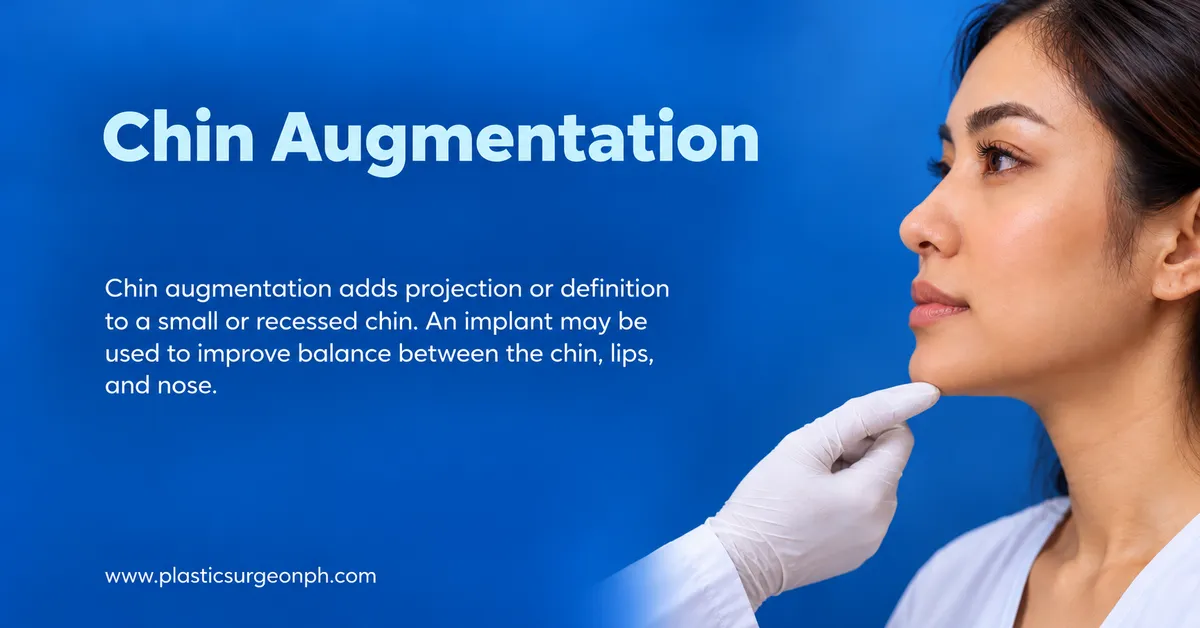
Chin augmentation improves projection or contour of a small or recessed chin, most commonly with an implant. A stronger chin can balance the nose, lips and jawline, but it cannot correct every lower-jaw or bite problem. The first decision is therefore diagnostic: does the patient need more chin contour, movement of the chin bone or corrective jaw surgery?
What is chin augmentation, and what concerns does it address?
Chin augmentation increases chin projection, height, width or definition. A solid implant is placed directly over the front of the lower jaw bone to improve facial balance. It may help a chin that appears small in profile, blends into the neck or seems out of proportion with the nose and midface.
The procedure changes the chin contour but not the position of the teeth or whole lower jaw. A patient with a significant overbite, underbite, jaw asymmetry or sleep-related airway issue may require orthodontic and maxillofacial assessment. Chin augmentation can accompany rhinoplasty because chin projection changes how large the nose appears, but combined surgery should only be recommended when both concerns are genuine. The chin implant and genioplasty comparison explains useful questions about changing chin projection with an implant or bone surgery.
Who is a good candidate for chin augmentation, and who is not?
Good candidates have completed facial growth, a stable bite, a small or poorly defined chin suitable for implant correction, good health and realistic expectations. Skin and soft-tissue thickness should be adequate to cover the implant. Patients should understand the intended change from front, profile and three-quarter views.
An implant is not ideal when the chin needs major vertical change, complex asymmetry correction or movement backward. Active dental or oral infection, uncontrolled disease, continued nicotine use and unrealistic expectations require postponement. Significant bite or jaw discrepancy should be assessed before cosmetic camouflage. Very thin tissues or previous implant complications may favour bone movement or another plan.
What are the different types or techniques used in chin augmentation?
Chin implants come in different widths, projections and shapes. Extended anatomical implants wrap farther along the lower jaw and can improve the prejowl contour. Silicone implants are smooth, solid and removable. Porous polyethylene and other materials allow more tissue integration but can be harder to remove. Availability and regulatory status should be confirmed for the specific product.
The implant can be inserted through an incision beneath the chin or inside the lower lip. A precise pocket is created over the bone and beneath soft tissue, then the implant is centred and sometimes secured with sutures or screws. Custom implants based on three-dimensional imaging may be considered for unusual asymmetry, although they add cost and planning.
Are there non-surgical alternatives to chin augmentation?
Hyaluronic acid or other approved filler can temporarily increase projection and help a patient preview a modest change. Results usually require maintenance. Filler is less suitable for large corrections and carries risks including lumps, infection and vascular injury. Biostimulatory injectables create less immediately reversible volume and need careful selection.
Fat grafting can add soft volume but is less precise for firm skeletal projection. Sliding genioplasty moves the patient’s chin bone and is often better for larger, vertical or asymmetric changes. Orthognathic surgery treats a jaw and bite discrepancy. The most appropriate alternative depends on whether the problem is soft tissue, chin bone or the entire jaw.
How do I prepare for chin augmentation?
The surgeon examines facial proportions, bite, lower-lip function, dental health, bone shape, skin thickness and neck contour. Photographs or imaging help compare implant sizes. Tell the surgeon about dental infection, braces, jaw symptoms, previous filler and facial surgery. Dental or maxillofacial review may be appropriate.
Stop nicotine as directed and coordinate changes to prescription medicines with the prescribing doctor. Complete required tests and medical clearance. For an intraoral incision, excellent oral hygiene is important and active dental work or infection must be resolved. Arrange transport, soft foods, leave from work and an adult companion if sedation or general anaesthesia is used.
How is chin augmentation performed, and how long does it take?
After anaesthesia, the surgeon creates an incision beneath the chin or inside the lower lip. A pocket is developed directly over the mandible, taking care around the mental nerves. The chosen implant is inserted, centred and secured when necessary. The incision is closed, and a supportive dressing may be placed.
The procedure commonly takes about one to two hours. Combined rhinoplasty, neck liposuction or jawline implants increase operating time. Chin augmentation is usually outpatient, although the setting and recovery plan depend on anaesthesia and other procedures.
What type of anesthesia is used, and who administers it?
Chin implant surgery may use local anaesthesia with oral or intravenous sedation. General anaesthesia is common when the procedure is combined with rhinoplasty or neck surgery, or when patient comfort and operating time make it preferable.
The surgeon injects local anaesthetic. A qualified anaesthesiologist should administer intravenous deep sedation or general anaesthesia and monitor the patient. Ask what level of anaesthesia is quoted, who provides it and what emergency and recovery resources the facility has.
What results can I realistically expect, and when will I see them?
The chin will have greater projection or definition, improving facial proportions and sometimes the apparent jawline. An implant cannot correct a malocclusion or make both sides perfectly identical. The result should look appropriate in motion and from multiple angles, not only in a posed profile photograph.
Change is visible immediately, but swelling may make the chin look too large or uneven. Most obvious swelling improves over two to four weeks. The implant and surrounding tissues continue settling for two to three months, and numbness or firmness may take longer to resolve.
Will I have scars after chin augmentation, and how visible will they be?
An external incision creates a short scar in the crease beneath the chin. It is often well concealed but can widen, darken or thicken. An intraoral incision leaves no visible skin scar, although it creates an internal scar and has different infection and lower-lip considerations.
The choice is not based on scar avoidance alone. The surgeon considers exposure, implant control, oral bacteria, nerve risk and any combined neck surgery. Follow wound care and sun protection instructions. Do not begin scar products or massage until approved.
What are the risks and possible complications of chin augmentation?
Risks include bleeding, infection, anaesthetic reaction, pain, numbness, scarring, asymmetry and dissatisfaction. Implant-specific problems include shifting, rotation, visibility, palpability, extrusion, rejection-like inflammation and erosion or resorption of underlying bone. Infection may require implant removal rather than antibiotics alone.
Mental nerve injury can cause lower-lip or chin numbness, and muscle disturbance can affect lip movement or create chin dimpling. An implant may be the wrong size or position. Seek prompt care for increasing pain, redness, fever, drainage, wound opening, sudden asymmetry, exposed material or progressive numbness and weakness.
What is recovery like after chin augmentation, and how long does it take?
Expect swelling, bruising, tightness and temporary numbness. A compression dressing may support the implant early. If the incision is inside the mouth, a liquid or soft diet and special mouth rinse may be prescribed. Keep the head elevated and avoid pressing or sleeping directly on the chin.
Many patients feel comfortable in public after one to two weeks. Residual swelling and firmness settle over several weeks to months. Avoid repeatedly pushing the implant to test whether it moves. Pain should improve, not steadily worsen.
When can I return to work, exercise, and normal activities?
Desk work often resumes after five to seven days, although visible swelling may make ten to fourteen days preferable. Talking and smiling can feel tight at first. Gentle walking is allowed early, while heavy exercise usually waits two to four weeks.
Contact sport, chin straps, motorcycle helmets and pressure on the chin require a longer restriction until the implant pocket is stable. Dental treatment may be postponed, particularly after an intraoral approach. Driving waits until no sedating medicine is needed and normal head movement is comfortable.
What aftercare and follow-up appointments are required?
Aftercare may include oral or skin-incision cleaning, prescribed medicine, mouth rinse, soft food and correct use of tape or compression. Maintain oral hygiene without brushing directly over an internal incision. Do not remove dressings, manipulate the implant or use unapproved massage.
Early follow-up checks position, nerve function and infection. Later visits monitor settling, smile movement and bone or soft-tissue response. Contact the surgeon urgently for fever, worsening pain, pus, wound opening, implant exposure, sudden movement or new weakness.
How long do the results of chin augmentation last?
Facial implants are designed for long-term or permanent use, but they are not lifetime guarantees. They can be removed or replaced if infection, movement, bone change, ageing or a change in preference occurs. The surrounding face and neck continue to age even when implant projection remains.
Avoiding trauma and treating dental or facial infection promptly support longevity. Routine replacement is not automatically required for every solid chin implant. Follow-up is based on symptoms, examination and the specific material.
How much does chin augmentation cost in the Philippines, and what is included in the price?
Public Philippine prices commonly start around PHP 45,000 to PHP 70,000 for silicone chin augmentation. Gore-Tex, porous or custom implants, hospital anaesthesia and combined procedures can bring the total to roughly PHP 80,000 to PHP 180,000 or more. A directory listing currently shows Manila chin implant starting prices near PHP 70,000.
The quote should identify the implant brand and material, surgeon, anaesthesiologist, facility, tests, medicines, dressings and follow-ups. Ask whether implant removal is covered if early infection occurs and whether a replacement implant would be an additional cost. Compare like with like, because filler, silicone implant and sliding genioplasty are entirely different treatments.
Thank you for sharing this article...
About the Author: Joan de Alta

View Surgeon Profiles

Completed plastic and reconstructive surgery training at MakatiMed in 2020.