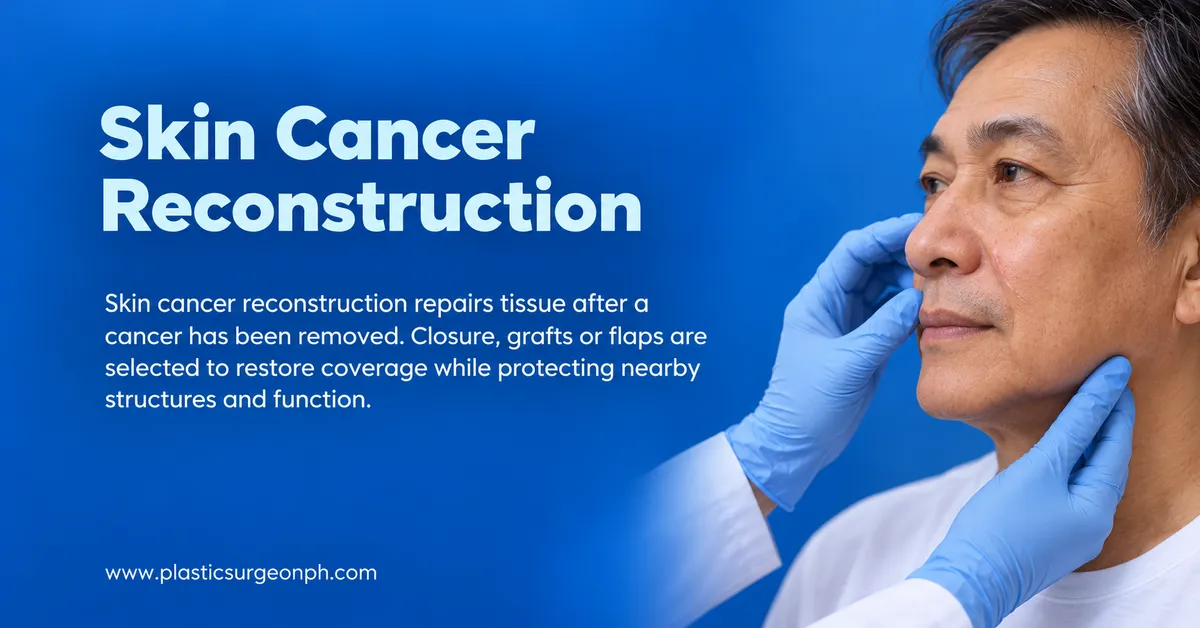
Skin cancer treatment has two linked priorities. The cancer must be removed with adequate margins, and the resulting wound should be repaired while protecting function. Reconstruction is particularly delicate around the eyelids, nose, lips, ears, scalp, hands and feet. The final plan depends on the tumour type, pathology, location and depth, not only on the visible spot. A plastic surgeon may perform both removal and reconstruction or work with a dermatologist, Mohs surgeon, head and neck surgeon or surgical oncologist.
What is Skin Cancer Reconstruction, and what concerns does it address?
Skin cancer reconstruction repairs the defect left after biopsy or complete removal of melanoma, basal cell carcinoma, squamous cell carcinoma or another tumour. The wound may involve skin alone or extend into fat, muscle, cartilage, bone, eyelid or lip lining. Reconstruction aims to close the wound securely, protect exposed structures and preserve important functions such as eyelid closure, nasal breathing, speech, eating and hand movement. It also seeks the best achievable match in colour, thickness, contour and facial landmarks. Cancer clearance always comes first. Making the wound smaller or prettier must never compromise adequate removal or delay necessary oncology treatment. After a skin tumour is removed, skin grafting may be considered for selected defects when the wound bed can support it. When nearby skin is limited, tissue expansion may be considered for selected staged repairs.
Who is a good candidate for Skin Cancer Reconstruction, and who is not?
Candidates include patients with a biopsy-proven or strongly suspected skin cancer whose removal will create a defect that cannot heal well on its own or close safely without distortion. People with exposed cartilage, bone, tendon or a wound near a free margin often benefit from specialist reconstruction. The operation may be delayed or modified if margins are uncertain, infection is uncontrolled, circulation is poor, or the patient is medically unstable. Nicotine use and uncontrolled diabetes raise wound risks. A person needing additional cancer treatment is not automatically unsuitable, but the reconstructive method must allow surveillance and timely radiotherapy or further excision. Comfort-focused care may be more appropriate in selected advanced illness.
What are the different types or techniques used in Skin Cancer Reconstruction?
Small defects may be closed directly after the edges are gently released. Healing by secondary intention, where the wound closes gradually with dressings, is suitable in selected concave areas. A skin graft transfers a thin or full-thickness piece of skin without its own blood supply. Local flaps rotate, advance or transpose neighbouring skin while keeping its circulation, often giving a better facial match. Regional or free flaps reconstruct larger three-dimensional defects, and cartilage or bone grafts can restore support. Staged forehead or cheek flaps may rebuild the nose. Eyelid, lip and ear repair uses specialised designs to preserve moving edges and lining.
Are there non-surgical alternatives to Skin Cancer Reconstruction?
There is no cosmetic substitute for medically adequate cancer treatment. Some superficial or selected cancers may be treated by a dermatologist or oncologist with topical medicines, curettage, cryotherapy, radiation, photodynamic therapy or systemic therapy, but these choices depend on tumour type and risk. They are alternatives to excision in particular cases, not general alternatives to reconstruction after a defect already exists. A very small wound may heal naturally with dressings, and a prosthesis may replace part of an ear or nose when further surgery is unsuitable or not desired. The cancer team should explain recurrence risk, pathology control and how each option affects later reconstruction and surveillance.
How do I prepare for Skin Cancer Reconstruction?
Bring the biopsy report, pathology slides if requested, photographs, imaging and a list of medicines and allergies. The team confirms the exact tumour, site, planned margin and whether margin assessment will occur before reconstruction. Discuss blood thinners with the prescribing doctor rather than stopping them yourself. Stop nicotine, optimise diabetes and arrange sun-safe wound care and transport. For a large or staged repair, prepare for dressings, possible hospital admission and help at home. Ask whether the cancer removal, frozen section or Mohs surgery and reconstruction will occur on the same day. Also ask what happens if a margin is positive, since the safest plan may be temporary coverage or further removal before definitive closure.
How is Skin Cancer Reconstruction performed, and how long does it take?
After the tumour is removed, the surgeon inspects the size, depth and missing tissue layers. Reconstruction may proceed after immediate margin assessment or after final pathology, depending on cancer type and setting. The wound edges are cleaned and prepared, then closed directly, allowed to granulate, grafted or covered with a flap. Cartilage, mucosa or bone may be added when structural support or lining is missing. A small closure can take 30 to 90 minutes. A local flap may take one to three hours, while major head and neck or microsurgical reconstruction can take six to twelve hours or longer. Some flaps require division at a second operation weeks later.
What type of anesthesia is used, and who administers it?
Small excisions and repairs may use local anaesthesia administered by the surgeon or dermatologist. Larger facial procedures may use local anaesthesia with sedation, while extensive, deep, paediatric or microsurgical reconstruction generally uses general anaesthesia. A qualified anaesthesiologist provides and monitors sedation or general anaesthesia and may add regional blocks for pain relief. The decision considers procedure length, airway access, age, medical conditions, bleeding risk and whether cancer removal and reconstruction are combined. Ask whether pathology services and the required operating-room resources are available. A properly equipped hospital is important for long procedures, significant medical illness, large blood loss or flap monitoring.
What results can I realistically expect, and when will I see them?
The wound is covered at surgery, but swelling, bruising, stitches and dressings initially obscure the result. A graft may look pale or mottled before developing circulation, and a flap can remain bulky for weeks. Contour and colour continue settling for six to twelve months. Further thinning, scar revision or reconstruction may be offered only after cancer safety and healing are clear. Function is the first measure of success, such as an eyelid that protects the eye or a nostril that remains open. Some asymmetry, numbness, colour difference or landmark distortion may remain. Reconstruction does not guarantee that the cancer will never return, so surveillance is part of the result.
Will I have scars after Skin Cancer Reconstruction, and how visible will they be?
Yes. Removing cancer creates a wound, and every surgical closure, graft and donor site heals with a scar. Surgeons place lines along creases and borders when this does not compromise cancer clearance or blood supply. Local flaps often create longer but better-positioned scars, while grafts may show a patch-like colour and contour difference. Staged nasal or ear reconstruction can leave a forehead, cheek or scalp donor scar. Scars are usually red or firm at first and soften over 12 to 18 months. Sun protection is crucial because ultraviolet exposure can darken scars and cause additional cancers. No technique can promise an invisible repair.
What are the risks and possible complications of Skin Cancer Reconstruction?
Risks include bleeding, infection, fluid collection, wound opening, delayed healing, pain, numbness and anaesthetic complications. A graft may partly or completely fail, and a flap can develop reduced blood supply or tissue loss. Facial repair may cause eyelid pulling, dry eye, nostril narrowing, lip asymmetry, difficulty opening the mouth or visible contour change. Donor sites can hurt or scar. Pathology may show a positive margin, deeper disease or a different diagnosis, requiring more surgery, lymph-node assessment, radiotherapy or another cancer treatment. Cancer can recur locally or elsewhere despite appropriate care. Promptly report a new lump, ulcer, bleeding spot or changing scar.
What is recovery like after Skin Cancer Reconstruction, and how long does it take?
A small closure may cause soreness and swelling for several days, with stitches removed in roughly one to two weeks. Grafts are commonly secured with a bolster dressing for about five to seven days and must be protected from rubbing or moisture as instructed. Local flaps need checks for colour and circulation, while free flaps require hospital monitoring. Facial bruising may last two weeks. Basic healing usually takes two to four weeks, but swelling, firmness and numbness improve over months. Staged flaps require another procedure. Radiation or further cancer surgery can change the timetable, so recovery should be planned with the full oncology pathway rather than with reconstruction alone.
When can I return to work, exercise, and normal activities?
Many patients return to desk work after several days to two weeks, depending on wound size, visibility, pain and job exposure to dust or sun. Heavy lifting, bending and vigorous exercise are often limited for two to four weeks to reduce bleeding and tension, and longer after major flap surgery. Driving waits until vision, neck movement and alertness are safe and sedating medicines are no longer needed. Swimming is postponed until all wounds are closed. Outdoor workers need reliable sun protection and may require temporary modified duties. Your surgeon may give different restrictions for an eyelid, hand, scalp or lower-leg repair because circulation and functional demands differ.
What aftercare and follow-up appointments are required?
Follow instructions for dressings, ointment, bathing, elevation and medicines. Do not disturb a graft bolster or flap pedicle. Seek urgent advice for persistent bleeding, fever, worsening redness, severe pain, a dark or pale flap, sudden swelling, vision change or wound opening. Early appointments check healing and remove sutures. A separate visit reviews the final pathology and confirms whether margins are clear and whether more cancer treatment is needed. Long-term skin examinations are essential because a person with one skin cancer may develop another. Practise shade, protective clothing and broad-spectrum sunscreen, and learn how to check the scar, lymph-node areas and the rest of the skin.
How long do the results of Skin Cancer Reconstruction last?
A healed closure, graft or flap can provide lifelong coverage, although it ages and changes with surrounding tissues. Scar tightening, flap bulk, graft colour or radiation effects may lead to later refinement. The reconstruction can remain sound even if another skin cancer develops elsewhere. If the original cancer recurs beneath or beside a flap, further removal and reconstruction may be required. Durability therefore depends on both wound healing and cancer control. Protecting the area from sun, avoiding nicotine and attending surveillance preserve the result. Any sore that does not heal, new pigment, lump, bleeding or change within the reconstructed area deserves prompt assessment rather than self-treatment.
How much does Skin Cancer Reconstruction cost in the Philippines, and what is included in the price?
A small private excision and direct repair may cost roughly PHP 30,000 to PHP 80,000. Reconstruction with a graft or local flap may be about PHP 60,000 to PHP 250,000, while major staged or free-flap cases can exceed PHP 400,000. These are planning ranges, not package quotations. Confirm whether the estimate includes biopsy or Mohs removal, pathology and margin checks, surgeon and anaesthesiologist fees, operating room, hospital stay, graft or implant materials, medicines, dressings and follow-up. Cancer treatment and reconstruction may be billed by different specialists. PhilHealth has procedure-specific case rates that may reduce eligible bills. Ask the hospital billing office for the coded benefit and an itemised balance before treatment whenever timing permits.
Thank you for sharing this article...
About the Author: Joan de Alta

View Surgeon Profiles

Certified as a Diplomate by the Philippine Board of Plastic Surgery (PBPS).



Explore Available Clinics



Browse Other Procedures
Corrective jaw surgery repositions the jaws to improve bite and alignment.
Head and neck reconstruction repairs tissue to restore essential functions.