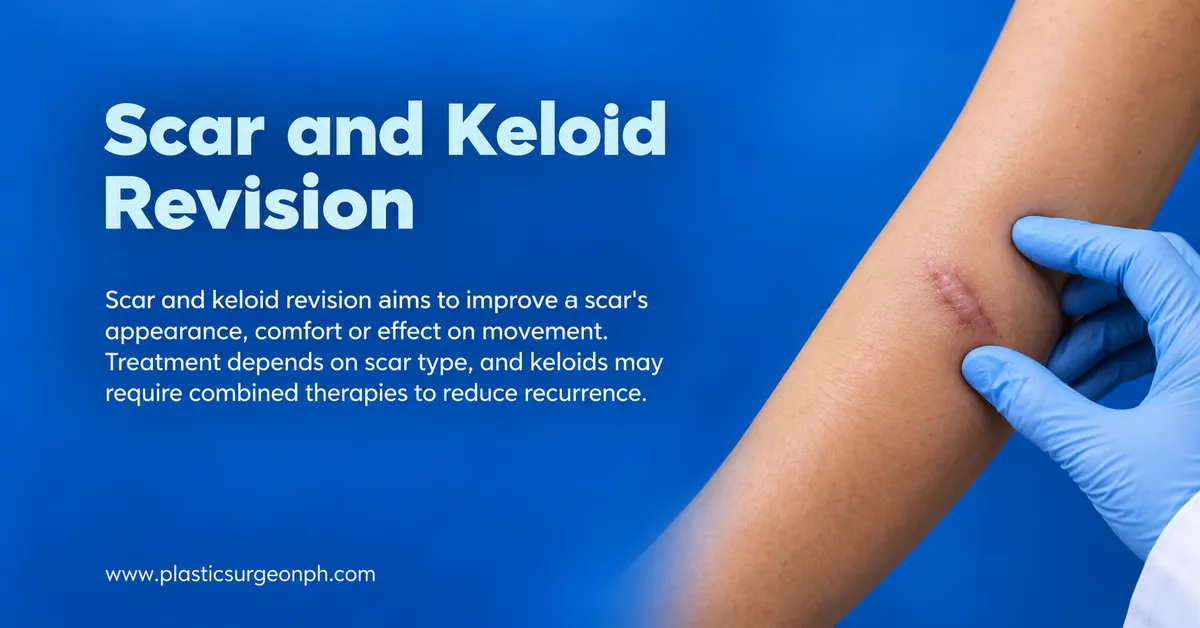
Scar revision aims to make a scar less noticeable, more comfortable or less restrictive, rather than remove every trace of it. Any cut reaching the deeper skin layers can leave a scar, including a carefully closed surgical incision. Keloids need particular caution: removing one without a recurrence-prevention plan can lead to regrowth, sometimes larger. The right approach depends on scar type, symptoms, location, skin tone, previous treatment response and your priorities.
What is scar revision, and how does keloid treatment differ?
Scar revision is a group of treatments used to improve a scar’s position, width, height, colour, texture, contour or effect on movement. A hypertrophic scar is raised but stays within the original wound. A keloid grows beyond the wound boundary and may itch, hurt or continue enlarging. Other patterns include widened, depressed, tethered, unstable, pigmented and contracture scars. Revision may improve a facial scar, release tight skin across a joint, fill a depression or control a symptomatic keloid. The goal is a better scar, not scarless skin. Some colour or texture difference normally remains even after excellent healing. Scars left by a serious burn may be assessed as part of burn reconstruction, especially when tight tissue limits movement. A scarred or missing skin area may sometimes need skin grafting, depending on the wound bed and the amount of tissue available. Use the scar revision and keloid care comparison to prepare questions about the type of scar and the aim of treatment.
Who is a good candidate for Scar and Keloid Revision, and who is not?
Good candidates have a mature or clearly problematic scar, a specific concern that treatment can address, controlled medical conditions and realistic expectations. Earlier intervention may be appropriate for a scar that distorts an eyelid, restricts a joint, repeatedly breaks down or forms an actively growing keloid. Elective surgery may be delayed when an ordinary scar is still changing during its first year. Poor candidates for immediate revision include people with active infection, uncontrolled diabetes, poor blood supply, ongoing nicotine use or an untreated tendency to pick the wound. Someone with repeated keloids is not automatically unsuitable, but surgery alone is usually unwise and a combined recurrence-prevention plan is essential.
What techniques are used for scar revision?
Options include precise excision and layered closure, serial excision for a broad scar, and geometric broken-line, W-plasty or Z-plasty rearrangements that redirect or lengthen tissue. A tethered or depressed scar may be released by subcision and supported with fat grafting or another filler. Contractures can require a skin graft or local, regional or free flap. Surface treatments include dermabrasion and fractional, vascular or ablative lasers. Keloid plans may combine excision with steroid or 5-fluorouracil injections, pressure therapy, silicone, cryotherapy or carefully selected postoperative radiotherapy. No single technique suits every scar, and combining treatments is common.
Are there non-surgical alternatives to Scar and Keloid Revision?
Yes. A new or mildly raised scar may improve with time, sun protection, silicone gel or sheets, massage and pressure when appropriately prescribed. Steroid injections can soften and flatten hypertrophic scars and keloids, often over several sessions. Other selected options include 5-fluorouracil injections, cryotherapy, vascular or fractional laser, microneedling, camouflage and treatment for itch. Acne-scar management may use subcision, peels, energy devices or fillers depending on scar type. These treatments may reduce symptoms and visibility without excision, but they cannot fully remove a broad scar or release every deep contracture. Keloid injections and pressure therapy often continue even when surgery is chosen.
How do I prepare for Scar and Keloid Revision?
Before scar revision, explain how the injury occurred, how long the scar has been present, whether it grew beyond the original wound and which treatments you have tried. The surgeon examines skin tension, movement, sensation, colour, blood supply and signs of infection, and may photograph or measure the scar. A doubtful or changing lesion may need biopsy before it is treated as a scar. Stop nicotine, disclose supplements and medicines, and follow instructions about blood-thinning drugs. Protect the area from sun and avoid unapproved bleaching, peeling or injected products. If radiotherapy is proposed for a keloid, meet the radiation oncologist before surgery so timing is coordinated.
How is Scar and Keloid Revision performed, and how long does it take?
For a linear revision, the old scar is removed, nearby skin is gently released and the layers are closed to reduce tension and align the final line with natural creases when possible. Z-plasty or W-plasty creates small planned flaps that change direction or lengthen a tight scar. A graft or flap covers a larger defect. Keloid excision is performed carefully, followed by the agreed adjunct treatment. A small office procedure may take 30 to 90 minutes. Complex facial rearrangement, grafting or contracture release may take two to four hours or longer. Treatment sessions for injections or laser are usually shorter but repeated.
What type of anesthesia is used, and who administers it?
Small revisions and injections commonly use local anaesthesia given by the treating doctor. Wider or sensitive-area procedures may use local anaesthesia with monitored sedation, while major contracture release, grafting or flap reconstruction may require general anaesthesia. Sedation, regional blocks and general anaesthesia should be administered by a qualified anaesthesiologist with continuous monitoring. The choice depends on scar size and site, patient age, expected duration, airway access and medical health. Local anaesthesia reduces discomfort but does not remove all pressure or pulling sensations. If the procedure is in a clinic, ask what emergency equipment, trained staff and transfer arrangements are available.
What results can I realistically expect, and when will I see them?
The previous scar is replaced by a new controlled wound, so the area can initially look worse. Swelling and redness settle over weeks, while the new scar remodels for 12 to 18 months or longer. A raised scar may flatten after injections or laser over several sessions. A contracture release may improve movement immediately, but therapy is needed to preserve it. Colour mismatch, slight width or texture difference can remain. Keloids can recur despite careful combined treatment. A realistic success is a flatter, softer, better-aligned or less painful scar that interferes less with daily life, not the total disappearance of every mark or symptom.
Will I have scars after Scar and Keloid Revision, and how visible will they be?
Yes. Surgical revision exchanges one scar for another that is intended to heal in a more favourable shape, direction or position. The new line may be longer because a Z-plasty or broken-line pattern reduces tension and disguises the scar. Grafts and flaps create additional donor-site scars. Visibility depends on body site, skin tension, genetics, colour contrast, wound care and sun exposure. Chest, shoulders, jawline and earlobes are common keloid sites and remain prone to recurrence. The surgeon cannot guarantee a thin or skin-coloured line. Early follow-up allows prompt silicone, pressure, injection or laser treatment if the scar becomes thick or symptomatic.
What are the risks and possible complications of Scar and Keloid Revision?
Risks include bleeding, infection, delayed healing, wound separation, numbness, persistent pain, pigment change, contour irregularity, stitch marks and dissatisfaction. The new scar may widen, thicken or form another hypertrophic scar or keloid. Grafts may heal with a colour or texture mismatch, and a graft or flap can partly fail. Contractures can return. Steroid injections may thin or lighten the skin and create visible small vessels, while laser can burn or alter pigment if settings and aftercare are unsuitable. Radiotherapy has its own short-term skin effects and small long-term risks, so it is reserved for selected keloids after specialist discussion. More treatment may be needed.
What is recovery like after Scar and Keloid Revision, and how long does it take?
After a small excision, soreness and swelling are usually manageable for several days and stitches may be removed within one to two weeks, depending on location. Keep the wound clean, dry and protected from stretching. A graft or flap needs closer monitoring and several weeks of activity modification. Contracture release may require a splint and rehabilitation. Once the skin is securely closed, the surgeon may introduce silicone, massage or pressure. Keloid prevention may involve scheduled injections, pressure earrings or radiotherapy soon after excision. Basic wound healing usually takes two to three weeks, but scar maturation and the full treatment programme often continue for a year or more.
When can I return to work, exercise, and normal activities?
Many patients resume desk work within two to five days after a small local procedure, provided the site can be covered and pain is controlled. A facial revision may cause visible bruising for one to two weeks. Exercise that stretches or rubs the wound is commonly restricted for two to four weeks, and longer after a graft, flap or joint contracture release. Swimming waits until the wound is fully sealed. Driving is safe only when movement is unrestricted and no sedating medicine is being taken. Your return date should reflect the body area and job demands. A shoulder, hand or knee scar can need more protection than a similar-sized scar on a low-tension site.
What aftercare and follow-up appointments are required?
Follow instructions for dressings, cleansing, ointment and activity. Seek advice for spreading redness, fever, pus, wound opening, persistent bleeding, severe pain or rapid keloid enlargement. Reviews may occur within days, at stitch removal and periodically during scar maturation. Silicone, pressure, massage and sun protection should begin only when the surface is healed and the clinician approves. Keloid treatment often needs repeated injections every few weeks and surveillance for months. If radiotherapy is part of the plan, it is usually coordinated closely with excision and should not be arranged casually afterwards. Take consistent photographs and report early itching, firmness or thickening, since prompt treatment may limit recurrence.
How long do the results of Scar and Keloid Revision last?
A successfully revised ordinary scar can remain improved permanently once it matures, although ageing, weight change, sun exposure or new injury can alter the area. A released contracture can tighten again, particularly in children or after extensive burns. Keloids have a lifelong tendency to recur. The American Academy of Dermatology warns that excision alone has an extremely high return rate, which is why follow-up treatment matters. Recurrence may appear within months or later. Long-term sun protection, pressure or silicone when prescribed, and early review of new thickening help preserve the result. Future surgery in a keloid-prone person should always include a preventive scar plan.
How much does Scar and Keloid Revision cost in the Philippines, and what is included in the price?
Philippine prices depend on length, location and whether treatment is office-based or hospital-based. A rough private planning range is PHP 20,000 to PHP 80,000 for a small surgical revision, PHP 60,000 to PHP 200,000 or more for complex rearrangement, grafting or a flap, and roughly PHP 2,500 to PHP 10,000 per injection or laser session depending on the area and product. Ask whether the quotation includes consultation, surgeon, anaesthesia, facility, pathology, medicines, dressings, silicone, pressure devices, injections, laser and follow-up. Keloid radiotherapy is usually billed separately. PhilHealth coverage depends on diagnosis and the coded reconstructive procedure, so confirm the expected deduction with the hospital before admission.
Thank you for sharing this article...
About the Author: Joan de Alta

View Surgeon Profiles

Certified as a Diplomate by the Philippine Board of Plastic Surgery (PBPS).