Microsurgery is not one operation for one diagnosis. It is a precision method that lets reconstructive surgeons repair tiny blood vessels, nerves and lymphatic channels under magnification. It can save an amputated finger, transfer living tissue to a cancer or trauma defect, and restore coverage where nearby tissue is inadequate. Successful microsurgery depends on more than technical suturing. Careful patient selection, a trained team, specialised equipment and intensive monitoring after the operation are equally important.
What is Microsurgery, and what concerns does it address?
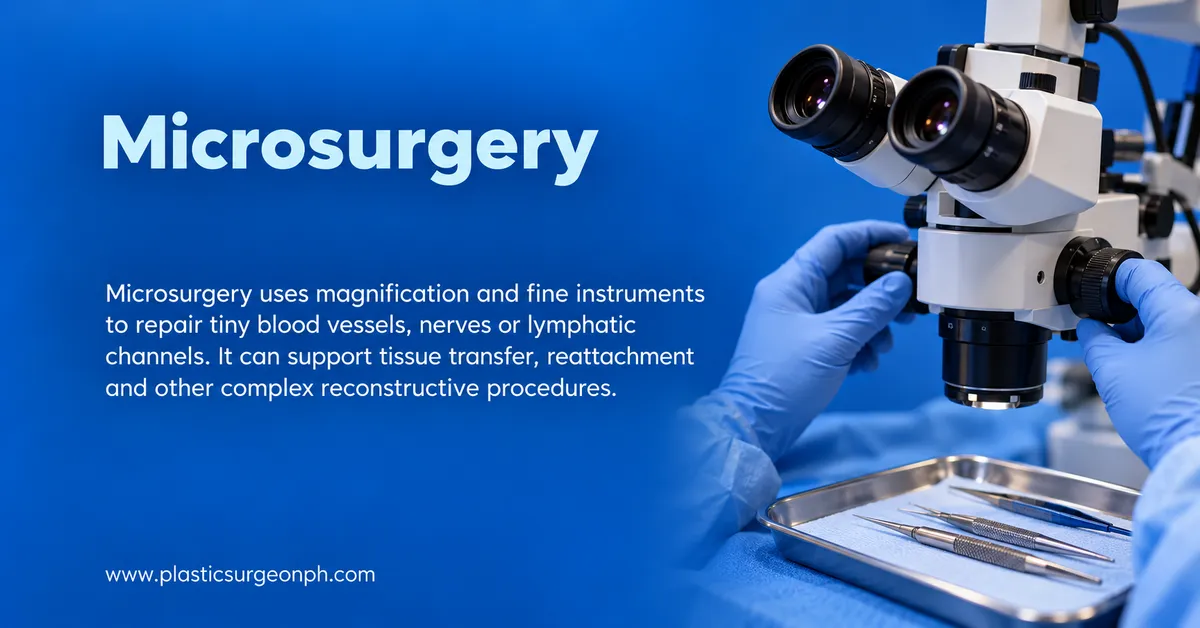
Microsurgery uses an operating microscope or high-power loupes and very fine instruments to join structures only a few millimetres wide. In free tissue transfer, skin, fat, muscle, bone or a combination is detached from one body area and reconnected to recipient arteries and veins elsewhere. Replantation reconnects an amputated digit or limb. Nerve microsurgery may repair or graft a divided nerve, while selected lymphatic procedures address lymphoedema. The method treats complex wounds after trauma, cancer, infection or congenital conditions and may support limb salvage, jaw reconstruction or functional muscle transfer. It cannot reverse every consequence of severe tissue loss, radiation or nerve damage. Repairing a small nerve may call for the techniques discussed in nerve repair and reconstruction, although the best approach depends on the injury. Reconnecting an amputated part through replantation surgery is one application of microvascular techniques.
Who is a good candidate for Microsurgery, and who is not?
Candidates have a defect for which free tissue, replantation, nerve repair or lymphatic reconstruction offers a meaningful advantage over simpler options. They need adequate recipient blood vessels, a medically acceptable anaesthetic risk and the ability to follow prolonged recovery and rehabilitation. Emergency candidacy also depends on how the amputated part was injured, time without circulation and contamination. Uncontrolled infection, severe vascular disease, unstable heart or lung illness, malnutrition and active nicotine use raise failure risk. A patient may be better served by a local flap, prosthesis or amputation if microsurgery would create excessive risk without useful function. Age is considered together with health and goals, not used alone.
What are the different types or techniques used in Microsurgery?
Free flaps may transfer skin and fat, muscle, bone, intestine or combinations. Common examples include anterolateral thigh, radial forearm, fibula and latissimus flaps, selected according to the missing tissue and donor impact. Surgeons connect one artery and one or more veins with tiny sutures or a coupling device. Replantation repairs bone, tendons, arteries, veins, nerves and skin in an organised sequence. Nerve procedures include direct repair, autograft, processed graft, nerve transfer and functional muscle transfer. Lymphaticovenous anastomosis connects small lymphatic channels to veins, while vascularised lymph-node transfer brings lymphatic tissue. Supermicrosurgery works on even smaller structures in specialised centres.
Are there non-surgical alternatives to Microsurgery?
Alternatives depend on the problem. A skin graft, local or regional flap may cover a smaller wound without microvascular transfer. Negative-pressure dressings can prepare or temporarily protect a wound. A prosthesis, orthosis or amputation may provide dependable function when limb salvage would require many high-risk operations. Nerve symptoms may be managed with therapy, splinting or pain care when repair is unlikely to help. Lymphoedema is first treated with compression, exercise, skin care and specialised therapy. These measures remain necessary even after lymphatic surgery. No non-surgical treatment can reconnect a completely divided artery or replant an amputated part, and delay can remove the opportunity for emergency microsurgery.
How do I prepare for Microsurgery?
Preparation includes a detailed examination of the defect and possible donor sites, photographs, laboratory tests and often CT angiography, Doppler ultrasound or other vessel mapping. The team reviews previous surgery, radiation, blood clots, medicines, allergies and blood-transfusion preferences. Stop all nicotine well in advance and optimise nutrition, anaemia, diabetes and infection. Ask which tissue will be transferred, what function or scar the donor site may lose, and what backup plan will be used if vessels are unsuitable. Arrange substantial home help and rehabilitation. For emergency replantation, do not eat or drink, and transport the wrapped amputated part in a sealed bag cooled by ice water, never directly on ice. For consultation research, review Dr. Glenn Angelo Genuino’s profile, then confirm experience with this operation, credentials, and follow-up arrangements directly.
How is Microsurgery performed, and how long does it take?
Two surgical teams may work together, one preparing the wound and recipient vessels while the other raises the donor tissue. The flap’s artery and veins are divided, the tissue is moved, and vessels are joined under magnification. The surgeon checks blood flow before shaping and closing the reconstruction. Bone, tendon or nerve repairs may be added, and monitoring probes or a visible skin segment may help observation. A straightforward free flap often takes six to ten hours, while complex head and neck, bone, replantation or multiple-flap cases can take twelve hours or longer. Re-exploration may be urgently required if a clot threatens circulation after surgery.
What type of anesthesia is used, and who administers it?
Most free flaps, major replantations and functional muscle transfers use general anaesthesia. Selected smaller nerve or lymphatic procedures may use regional or local anaesthesia with sedation. A qualified anaesthesiologist provides continuous monitoring, temperature control, fluids, blood products, pain relief and prevention of blood clots while maintaining conditions that support flap circulation. Long operations increase risks from pressure, fluid shifts and hypothermia, so anaesthesia and nursing experience matter. Postoperative care may occur in a specialised ward or intensive care unit. Ask whether the hospital has round-the-clock staff who recognise flap compromise and whether the microsurgical team can return to theatre promptly if needed.
What results can I realistically expect, and when will I see them?
Living tissue coverage is immediate, but swelling and dressings make the first appearance misleading. The urgent early measure is reliable circulation, not contour. A flap may remain bulky and later need thinning. Transferred bone takes months to unite, while repaired nerves and functioning muscle may improve for one to two years with therapy. Replanted parts commonly remain stiffer, weaker, colder or less sensitive than before injury. Lymphatic surgery may reduce swelling gradually and does not always eliminate compression garments. Most modern free flaps survive in experienced centres, but no team can promise success. The realistic aim is durable tissue, protected structures and worthwhile function with acceptable donor-site trade-offs.
Will I have scars after Microsurgery, and how visible will they be?
Yes. There are scars at both the reconstructed area and the donor site, and the transferred tissue may have a visible colour, thickness or hair-bearing difference. A thigh donor scar may be long, a forearm site may require a graft, and fibula harvest leaves a leg scar. Replantation scars often follow the irregular injury. Surgeons place incisions and choose donor tissue to balance function, concealment and safety, but blood supply takes priority. Scars generally soften for 12 to 18 months. Later procedures may refine contour or revise a scar after circulation is stable. Patients should understand the donor-site appearance before consent rather than discovering it after surgery.
What are the risks and possible complications of Microsurgery?
The defining risk is a clot in the tiny artery or vein, which can threaten the entire flap or replanted part. Urgent re-exploration may restore flow, but partial or complete tissue loss can occur and require another flap, graft or amputation. Other risks include bleeding, transfusion, infection, wound opening, fluid collection, blood clots in the legs or lungs, pneumonia, pressure injury and anaesthetic complications. Donor sites can develop weakness, numbness, poor healing, fracture, hernia or contour change depending on the tissue taken. Nerves may recover incompletely, bone may not unite, and chronic pain can persist. More operations and prolonged rehabilitation are common in complex cases.
What is recovery like after Microsurgery, and how long does it take?
During the first several days, nurses check colour, warmth, capillary refill and Doppler signals frequently, including overnight. The reconstructed part is positioned carefully and protected from pressure. You may have drains, urinary catheter, intravenous lines, blood-thinning medicine and a feeding tube depending on the case. Mobilisation begins safely to reduce clots and lung problems, while the flap or repaired limb follows specific weight-bearing limits. Hospital stay is often five to fourteen days but can be longer. Wounds heal over several weeks, basic daily activity returns over two to three months, and bone, nerve or functional recovery can continue for one to two years.
When can I return to work, exercise, and normal activities?
Office work may be possible after six to twelve weeks for an uncomplicated reconstruction, while manual work often requires three to six months or more. Head and neck patients may also need speech and swallowing rehabilitation. Lower-limb flaps follow a staged dangling and weight-bearing programme; progressing too quickly can cause swelling or wound breakdown. Gym exercise and lifting restart only when donor and recipient sites are strong. Driving waits until reaction, vision, limb control and alertness are safe without sedating medicine. Replantation, bone transfer and functional muscle procedures have individual schedules. A gradual return coordinated by the surgeon and therapists is more reliable than a fixed date based only on wound closure.
What aftercare and follow-up appointments are required?
Never place pressure, tight clothing, ice, heat or unapproved compression on a new flap. Avoid nicotine completely and take medicines as prescribed. Report colour change, coolness, sudden swelling, new severe pain, bleeding, fever, foul drainage, shortness of breath or calf pain immediately. Early visits assess circulation and wounds, then remove drains or sutures and guide movement. Later follow-up checks bone union, sensation, donor-site function, lymphoedema or cancer surveillance. Physiotherapy, occupational therapy, speech therapy and nutrition may all be required. A free flap is not finished when it survives the first week. Rehabilitation and planned refinements determine how useful the reconstruction becomes.
How long do the results of Microsurgery last?
A successfully healed free flap develops additional circulation from surrounding tissue and can last for life. It ages, gains or loses weight and may be affected by radiation or recurrent disease. Replanted parts can remain functional permanently but may develop stiffness, cold intolerance, arthritis or altered sensation. Transferred bone can unite strongly, although hardware or dental reconstruction may later need attention. Lymphatic procedures may provide lasting improvement but usually remain part of long-term compression and skin care. Donor-site effects can also be permanent. Protecting numb tissue, maintaining health and attending surveillance help preserve the result. Future refinement does not mean the original microsurgery failed.
How much does Microsurgery cost in the Philippines, and what is included in the price?
Microsurgery is among the most resource-intensive reconstructive care. A private nerve repair or selected small microsurgical procedure may start around PHP 150,000 to PHP 350,000. Free-flap reconstruction or replantation may cost roughly PHP 400,000 to more than PHP 1,500,000, particularly with long theatre time, implants, intensive monitoring or complications. Ask for an itemised estimate covering two surgical teams if needed, anaesthesiologist, microscope and instruments, imaging, implants, blood, operating room, ICU or ward stay, medicines, flap monitoring, donor-site care and rehabilitation. PhilHealth may apply several procedure-specific case rates, but these are deductions rather than total prices. Tertiary government hospitals may substantially reduce direct charges for eligible patients.
Thank you for sharing this article...
About the Author: Joan de Alta