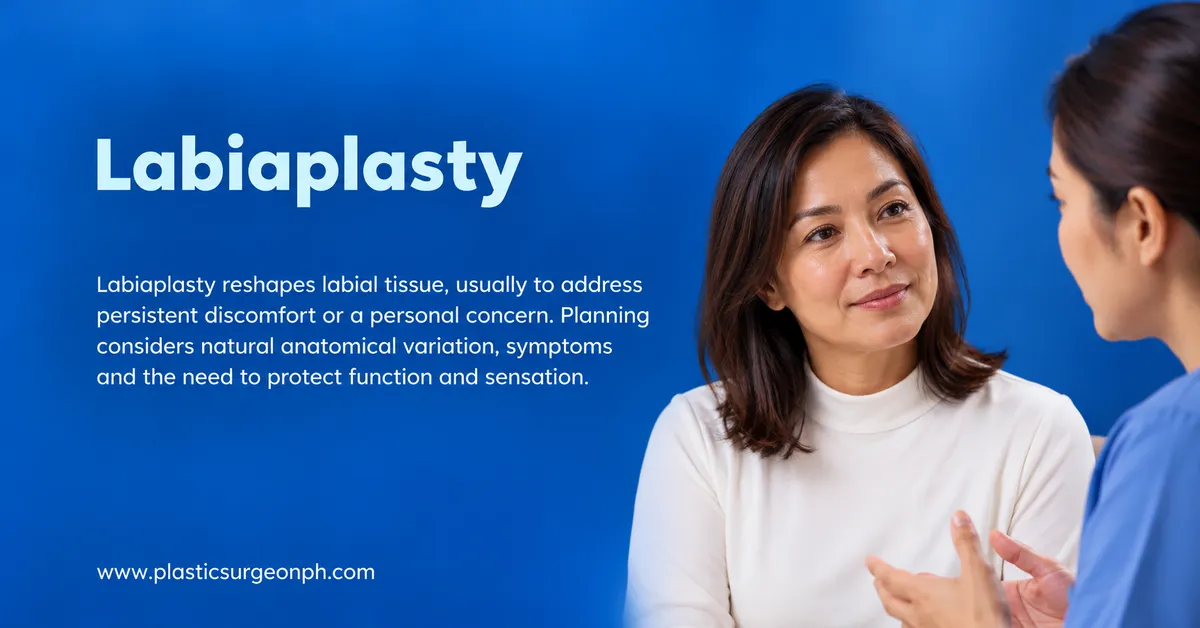
Labiaplasty reshapes the labia, most commonly by reducing part of the labia minora. Labia naturally vary greatly in size, colour, edge shape and symmetry, and variation alone is not a disease. Some patients seek surgery because of persistent pulling, irritation or discomfort, while others have a personal aesthetic concern. A respectful consultation should explain normal anatomy, exclude infection or skin disease, and protect the patient’s independent choice. The procedure does not tighten the vagina and cannot guarantee improved sexual confidence or function.
What is labiaplasty, and what concerns does it address?
Labiaplasty is surgery to reduce or reshape labial tissue, usually the inner lips called the labia minora and less often the outer labia majora. It may address rubbing in clothing, pulling during cycling or intercourse, recurrent irritation, asymmetry after childbirth or repair of an injury. Aesthetic concerns may also be considered after informed discussion. The operation should preserve sensation, moisture protection and a natural edge. It is distinct from vaginoplasty, which addresses the vaginal canal, and from non-consensual genital cutting. Clitoral hood reduction is a separate procedure and should be performed only for a specific indication, with consent and careful nerve protection. A vaginoplasty and surgical vaginal rejuvenation concerns the vaginal canal rather than the labia, so the aims and risks need separate discussion. If the concern is the pubic mound above the labia, monsplasty addresses that separate area.
Who is a good candidate for labiaplasty, and who is not?
A good adult candidate has persistent symptoms or a considered personal concern, realistic expectations and no active infection or untreated skin condition. The decision should be voluntary and free from partner, family or social pressure. Candidates must accept temporary sexual and exercise restrictions. Surgery should be postponed during pregnancy, active genital infection, uncontrolled illness, nicotine use or unstable mental health that affects consent. A patient expecting greater orgasm, relationship repair or an airbrushed appearance is unlikely to be satisfied. For adolescents, normal development is still changing. Surgery is generally reserved for significant functional or reconstructive reasons after careful specialist evaluation, safeguarding and age-appropriate consent.
What are the different types or techniques used in labiaplasty?
The trim technique removes tissue along the projecting edge and creates a new border. It can reduce dark or irregular edges but leaves a scar along the length. The wedge technique removes a central triangular segment and preserves much of the natural edge, although the closure can separate. De-epithelialisation removes surface tissue while preserving the edge but suits only limited reduction because it may make the labium thicker. The surgeon may tailor asymmetry rather than remove equal amounts. Labia majora reduction or fat grafting addresses different concerns. Clitoral hood reduction is not an automatic add-on and must avoid excessive removal or nerve injury.
Are there non-surgical alternatives to labiaplasty?
Many patients improve symptoms without surgery. Properly fitted underwear, changing cycling seats or clothing, barrier ointment, lubrication and avoiding irritating cleansers may reduce rubbing. A gynaecologist or dermatologist can diagnose dermatitis, lichen sclerosus, yeast infection, pain disorders or hormonal dryness that surgery will not cure. Pelvic floor therapy may help pelvic pain or painful intercourse when muscle overactivity is involved. Counselling can help body-image distress and clarify whether external expectations are influencing the request. Energy-based vaginal devices and injectable fillers do not reproduce tissue reduction and may cause burns, scarring, nodules or pain. Observation remains a valid choice because broad anatomical variation is normal.
How do I prepare for labiaplasty?
Preparation includes a private history and examination with consent. The surgeon should identify the exact tissue causing symptoms, discuss normal variation and screen for infection, skin disease, pelvic pain and coercion. Pregnancy testing or laboratory tests may be required. Stop nicotine and coordinate anticoagulants and supplements with the appropriate doctor. Time surgery away from menstruation when practical, although this is not always essential. Arrange transport, loose cotton underwear, sanitary pads, a clean washing method and several days of help. Ask about technique, how much tissue will remain, emergency contact, privacy of records, chaperone policy and what happens if wound separation or painful scarring occurs.
How is labiaplasty performed, and how long does it take?
The surgeon confirms the markings while preserving enough tissue for protection and a natural contour. Local anaesthetic is placed, the planned trim, wedge or limited surface excision is performed, bleeding is controlled and the edges are closed with fine absorbable sutures. The two sides may need different amounts of reshaping because natural asymmetry is common. A straightforward labia minora procedure usually takes about one to two hours. Labia majora reduction, reconstruction or carefully indicated hood work can take longer. Most patients go home the same day after urinating comfortably and receiving written hygiene, pain-control and emergency instructions.
What type of anesthesia is used, and who administers it?
Labiaplasty may be performed under local anaesthesia alone, local anaesthesia with monitored sedation or general anaesthesia. Choice depends on extent, patient comfort, medical history and facility. The surgeon commonly administers local anaesthetic. If sedation or general anaesthesia is used, a qualified anaesthesia professional should administer and monitor it, following local facility requirements. Monitoring includes breathing, circulation and comfort. Disclose allergies, sleep apnoea, previous anaesthetic problems, medicines and supplements. Ask who will provide sedation, whether an anaesthesiologist will be present, and how privacy and safety are maintained. A brief operation still requires sterile technique and appropriate emergency equipment.
What results can I realistically expect, and when will I see them?
The intended result is less projection or improved symmetry while preserving function and a natural appearance. Early swelling can make the labia look larger, uneven or firm, so the first days do not predict the final shape. Bruising and swelling improve substantially over two to six weeks. Fine residual swelling and scar firmness may take three to six months to settle. Perfect symmetry is neither normal nor guaranteed. Sensation may feel temporarily reduced or unusually sensitive. Surgery cannot promise greater sexual pleasure, eliminate all rubbing or produce a standardised appearance. Final assessment should wait until tissues are fully soft and no longer swollen.
Will I have scars after labiaplasty, and how visible will they be?
Yes, but scars usually lie within the natural folds and colour transitions of the vulva. A trim scar follows the new labial edge, while a wedge leaves shorter lines across the tissue. Scars are swollen and tender at first, then usually soften and become difficult to notice over several months. However, a scar can remain firm, raised, sensitive, notched or visible. Wedge closure can separate and create an irregular edge. Excessive removal can cause tightness or distortion that is difficult to correct. No responsible surgeon should promise no scar. Scar massage or topical treatment should begin only after complete healing and direct medical advice.
What are the risks and possible complications of labiaplasty?
Risks include bleeding, haematoma, infection, wound separation, delayed healing, asymmetry, edge notching, over-resection, under-resection and an unwanted scar. Temporary numbness, hypersensitivity, pain with intercourse and urinary spraying can occur. Rarely, altered sensation, chronic pain, dryness, tightness or tissue loss persists. Injury near the clitoral nerves can impair sensation, which is why unnecessary hood surgery is avoided. Revision is difficult when too much tissue has been removed. Seek urgent review for heavy bleeding, a rapidly expanding painful swelling, fever, pus, inability to urinate, dark tissue or severe pain. Persistent burning or itching may represent a skin condition rather than surgical failure.
What is recovery like after labiaplasty, and how long does it take?
Swelling, bruising and stinging are most noticeable during the first several days. Patients use loose underwear or clothing and a clean pad for light spotting. Gentle washing and patting dry protect the incision. Short periods of cool compress may be advised, but ice should not touch skin directly. Sitting may be uncomfortable, and prolonged pressure is limited. Absorbable sutures gradually dissolve. Many patients feel much better after one to two weeks, but swelling can fluctuate for six weeks or longer. Small wound separations may heal with local care. Worsening pain, fever, foul discharge, heavy bleeding or difficulty urinating requires prompt review.
When can I return to work, exercise, and normal activities?
Desk work often resumes within three to seven days, although longer may be needed for significant swelling or a physical job. Gentle walking starts early. Driving waits until sitting is comfortable and sedating medicine has stopped. Running, cycling, vigorous lower-body exercise and swimming usually wait four to six weeks and until wounds are fully closed. Tampons, penetrative sex and any activity that stretches or rubs the labia are generally restricted for about six weeks or until the surgeon confirms healing. Menstrual pads are used instead of internal products during early recovery. Return dates should follow examination rather than a social-media recovery claim.
What aftercare and follow-up appointments are required?
Aftercare focuses on gentle hygiene, keeping the area dry, using prescribed pain relief and avoiding friction. Wash hands before touching the wound and do not apply feminine washes, antiseptics, powders or herbal products unless prescribed. A pad can protect clothing, but it should be changed regularly. Early follow-up checks bleeding, swelling, urination, infection and wound closure. Later visits assess symmetry, sensation, scars and readiness for sex and exercise. Contact the team for increasing redness, fever, pus, severe pain, heavy bleeding or wound opening. Do not trim sutures or self-treat a separated wedge. Privacy and respectful examination should continue at every visit.
How long do the results of labiaplasty last?
Removed tissue does not grow back, so the reduction is generally long-lasting. Ageing, hormonal change, childbirth, injury and tissue stretching can alter the appearance later. Pregnancy after labiaplasty is possible, but vaginal delivery may change the result. Weight change affects the labia majora more than the trimmed inner labia. Symptoms caused by dermatitis, dryness or pelvic floor dysfunction can recur because surgery does not treat those conditions. Revision may be considered after complete healing for persistent asymmetry or scar problems, but replacing tissue after excessive removal is difficult. Conservative initial surgery therefore protects both function and future options.
How much does labiaplasty cost in the Philippines, and what is included in the price?
Published Philippine estimates range from about PHP 45,000 to PHP 120,000, with the total depending on technique, anaesthesia, facility and whether reconstructive or additional procedures are required. The written quotation should state exactly which tissue is treated and include the surgeon, anaesthesia provider where applicable, clinic or hospital, laboratory tests, medicines, dressings and follow-up. Ask whether pathology, treatment of wound separation, additional facility time or revision is separate. A price for simple local-anaesthetic trimming should not be compared directly with reconstruction under general anaesthesia. Credentials, consent quality, privacy and access to postoperative care are more important than a bargain package.
Thank you for sharing this article...
About the Author: Joan de Alta