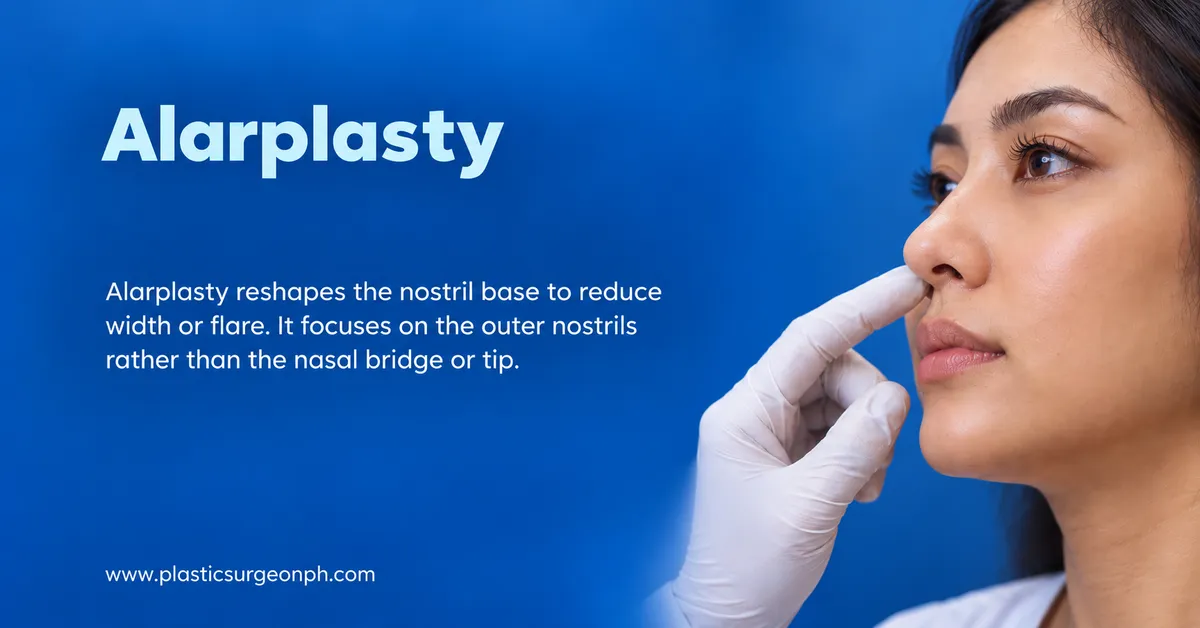
Alarplasty, also called alar base reduction or nostril reduction, is a focused operation for the lower part of the nose. Although it is smaller in scope than full rhinoplasty, it requires conservative planning. Removing too little may produce minimal change, while removing too much can create notching, unnatural nostrils or breathing difficulty. The best result narrows or refines the nasal base without erasing normal curves or making the nose look pinched.
What is alarplasty, and what concerns does it address?
Alarplasty changes the width, flare or shape of the alae, which are the outer walls of the nostrils. It may help when the nasal base appears disproportionately wide, the nostrils flare at rest, one nostril is larger than the other, or the nostril sill is broad. It can be performed alone or as the final part of a comprehensive rhinoplasty.
The operation does not raise a low bridge, refine a broad tip, straighten nasal bones or correct most internal causes of obstruction. Patients sometimes assume that narrowing the nostrils will make every part of the nose smaller. In reality, alarplasty changes one specific region. The surgeon must assess the bridge, tip projection, columella, nostril shape, facial width and airway before deciding whether isolated treatment will look balanced. For a concern confined mainly to the nasal tip, tip plasty is another focused option to discuss. The comparison of rhinoplasty, tip plasty, and alarplasty explains these different treatment areas.
Who is a good candidate for alarplasty, and who is not?
A suitable candidate is healthy, has completed nasal growth, does not smoke or can stop nicotine, and has a clearly identifiable concern involving alar flare or base width. The patient should accept that mild pre-existing asymmetry may remain. Alarplasty can be appropriate for Filipino patients who want a subtle reduction while retaining natural ethnic features, provided the plan is based on the individual’s face rather than a standard measurement.
It is not appropriate when the main concern comes from the bridge, tip, septum or jaw balance. Patients with nasal valve weakness, significant obstruction, unrealistic expectations, active infection, uncontrolled illness or poor healing risk need further assessment. Very aggressive narrowing is unsuitable because the nostrils are part of the airway. Anyone requesting an extremely pinched or identical nostril shape should understand the functional and anatomical limits.
What are the different types or techniques used in alarplasty?
An alar wedge excision removes a carefully measured wedge of tissue near the groove where the nostril meets the cheek. It mainly reduces flare. A sill excision removes tissue from the floor of the nostril and is more useful for reducing base width. A combined wedge and sill excision may address both problems. Surgeons modify incision patterns to preserve a natural nostril curve and place the scar within a crease.
An alar cinching suture can pull the bases inward without the same external excision, but its effect and stability depend on anatomy and technique. Some patients need cartilage support or a flap rather than simple removal, particularly when the nostril wall is weak or previously over-resected. Conservative markings and repeated assessment are essential because tissue that has been removed cannot simply be replaced.
Are there non-surgical alternatives to alarplasty?
Botulinum toxin may slightly reduce nostril flare caused mainly by muscle movement, particularly during smiling. The effect is modest and temporary, and poor placement can alter upper-lip movement. Filler can sometimes improve surrounding proportions, but it cannot physically narrow the nasal base. In fact, adding volume may make a wide nose appear broader from some angles.
Threads and external devices do not permanently reduce nostril width. Makeup and photographic contouring can change appearance without medical risk. If the concern is caused by tip shape or low bridge projection, a different surgical or nonsurgical approach may create better balance. Patients with breathing symptoms need an airway assessment rather than cosmetic camouflage.
How do I prepare for alarplasty?
The surgeon should examine the nose from the front, side, base and during smiling. Standardised photographs help compare resting flare, dynamic flare and existing asymmetry. Discuss any previous nose procedure, filler, threads, trauma, breathing problem, allergy, scar tendency and current medicine or supplement. Preoperative testing depends on health, anaesthesia and facility policy.
Stop nicotine for the period directed by the surgeon. Do not independently stop prescribed blood thinners. Coordinate changes with the prescribing physician. Keep the skin around the nose healthy and report pimples, wounds or infection near the planned incision. Arrange transport if sedation will be used, prepare soft and easy meals, and plan several days away from public-facing work.
How is alarplasty performed, and how long does it take?
After precise markings, local anaesthetic is injected. The surgeon removes a conservative amount of skin and soft tissue using the chosen wedge, sill or combined pattern. The nostril is brought inward without excessive tension, and the edges are closed in layers with fine sutures. Both sides are compared repeatedly, but natural differences mean exact mirror-image nostrils cannot be guaranteed.
Alarplasty commonly takes about thirty to ninety minutes. More time may be needed for asymmetry, scar revision or cartilage support. It is often an outpatient procedure. When performed as part of rhinoplasty, the alar base is usually assessed near the end because changes to the bridge and tip can alter how wide the base appears.
What type of anesthesia is used, and who administers it?
Isolated alarplasty is often possible under local anaesthesia. The patient remains awake, but the treated area is numb. Oral or intravenous sedation may be added for anxiety or comfort. General anaesthesia is more likely when alarplasty is combined with full rhinoplasty or another substantial procedure.
The surgeon may administer local anaesthetic within a properly equipped setting. Intravenous sedation or general anaesthesia should be managed and monitored by a qualified anaesthesiologist or another appropriately credentialled anaesthesia professional according to facility rules. Ask who will be present, how vital signs will be monitored and what emergency support is available.
What results can I realistically expect, and when will I see them?
The nasal base looks narrower immediately, but swelling and sutures can temporarily distort the shape. One side may settle faster. The first meaningful impression usually develops over several weeks, while the nostril edges and scars continue to soften for three to six months or longer.
A realistic result is a modest improvement in width or flare that remains proportionate to the face. Perfect symmetry, complete elimination of flare and a scar-free result are not realistic promises. The surgeon should avoid overcorrection because a natural, functioning nostril is more important than meeting an arbitrary width.
Will I have scars after alarplasty, and how visible will they be?
Yes. Alarplasty requires external incisions, usually hidden along the alar-facial groove, nostril sill or natural shadow at the nasal base. Early scars may look red, darker, raised or firm. Most become less obvious as they mature, but no surgeon can guarantee that they will disappear.
Scar visibility depends on incision design, tension, infection, sun exposure, skin type, genetics and aftercare. Conservative sun protection is important because ultraviolet exposure can darken a healing scar. Do not apply strong acids, bleaching agents, silicone or makeup until the surgeon confirms that the wound is ready.
What are the risks and possible complications of alarplasty?
Risks include bleeding, infection, delayed healing, pain, numbness, visible or thick scars, prolonged swelling, asymmetry and dissatisfaction. Procedure-specific complications include nostril notching, loss of the natural alar curve, an overly pinched appearance, distortion of the nostril sill and recurrence or undercorrection.
Over-resection can narrow the external nasal valve and cause breathing difficulty. Correcting an overdone alarplasty may require complex reconstruction with cartilage or composite grafts and cannot always restore the original anatomy. This is why a conservative first operation is preferable. Seek prompt care for increasing redness, pus, fever, severe pain, persistent bleeding, pale or dark skin, or new breathing difficulty.
What is recovery like after alarplasty, and how long does it take?
Swelling, tenderness and mild bruising are expected during the first several days. Small amounts of blood staining can occur early. External sutures are commonly removed within about five to seven days, depending on the material and surgeon. Most wounds are closed by one to two weeks, but redness and firmness may remain longer.
Keep the incision clean as instructed, sleep with the head elevated and avoid pulling the upper lip or nostril area. Do not pick crusts or repeatedly inspect the wound with unwashed hands. Social downtime is often about one week, although visible redness or swelling may last longer. Final scar maturation takes months.
When can I return to work, exercise, and normal activities?
Desk work may be possible after three to seven days if swelling is acceptable and no sedating medicine is required. Public-facing work may need a week or more. Gentle walking is usually encouraged, while bending, heavy lifting and vigorous exercise are restricted during early healing because they can increase bleeding and swelling.
Many patients gradually resume exercise after about two to four weeks with clearance. Contact sports and any activity that can hit or stretch the nose require a longer pause. Avoid swimming until the incisions are sealed and the surgeon approves it. Makeup, shaving and skincare near the wound also need specific clearance.
What aftercare and follow-up appointments are required?
Aftercare may include antibiotic ointment, gentle cleaning, prescribed pain relief and sometimes oral medicine. Use only products recommended by the surgical team. Protect the incision from pressure and sunlight. If the surgeon recommends paper tape, silicone or massage later, follow the exact timing because premature manipulation can open or irritate the wound.
The first review is usually within a week for wound and suture assessment. Later visits monitor nostril shape, breathing, scar colour and symmetry. Report increasing pain, warmth, discharge, fever, wound separation, persistent bleeding or a change in skin colour immediately rather than waiting for the next appointment.
How long do the results of alarplasty last?
The tissue removal and repositioning are intended to be permanent. Normal ageing, scar contraction, injury and changes from future rhinoplasty can still alter the appearance. A small degree of widening or asymmetry may emerge as swelling settles, but major relapse is not expected after proper healing.
Revision should be approached carefully because additional excision can create functional or reconstructive problems. Unless a medical issue requires early treatment, surgeons generally allow scars and swelling to mature before judging a cosmetic revision. Maintaining stable health and protecting the nose from trauma help preserve the result.
How much does alarplasty cost in the Philippines, and what is included in the price?
Publicly advertised starting prices in the Philippines may be around PHP 20,000 to PHP 25,000 for a basic isolated alar trim. More comprehensive quotations from qualified surgical practices or hospital-based settings may be about PHP 40,000 to PHP 80,000 or more, especially when sedation, asymmetry correction or cartilage support is required. Promotions may exclude important charges.
Ask for a written total that identifies the consultation, surgeon, anaesthesia, facility, medicines, laboratory tests, dressings, suture removal and follow-up visits. Confirm whether scar treatment and any unplanned hospital care are excluded. When alarplasty is added to rhinoplasty, request an itemised combined quotation rather than assuming the advertised price covers both procedures.
Thank you for sharing this article...
About the Author: Joan de Alta

View Surgeon Profiles

Certified as a Diplomate by the Philippine Board of Plastic Surgery (PBPS).