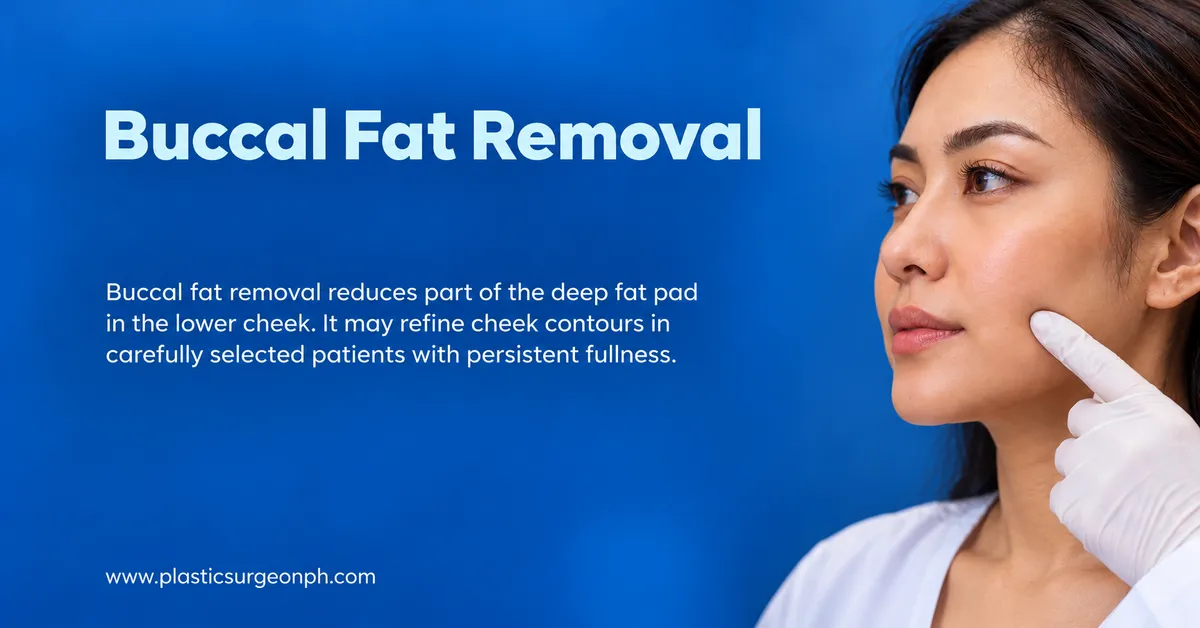
Buccal fat removal reduces a deep pad of fat in the lower cheek to create more visible cheek hollows. It became widely discussed through social media, but it is not a general treatment for every round face. The buccal fat pad contributes to youthful facial volume, and removing too much can make a person look prematurely hollow as ageing continues. Careful patient selection is therefore more important than the trend.
What is buccal fat removal, and what concerns does it address?
The buccal fat pad is a naturally occurring compartment between facial muscles. Buccal fat removal, sometimes called bichectomy, removes part of its cheek extension through an incision inside the mouth. It can reduce persistent lower-cheek fullness and create a more defined transition between the cheekbone and jawline.
A request for a cheek indentation involves a different goal. The guide to creating cheek dimples explains how dimpleplasty differs from reducing cheek volume.
It does not directly treat superficial facial fat, jowls, a wide jaw muscle, loose skin or a double chin. Weight loss may not greatly change buccal fat in some people, but a full facial assessment is still needed. The surgeon should identify whether roundness comes from bone, muscle, skin, superficial fat or the buccal pad before recommending removal. By contrast, cheek (malar) augmentation adds projection to the cheek area rather than reducing buccal fat. For a patient seeking added facial volume instead, facial fat grafting takes a different approach to the cheek contour.
Who is a good candidate for buccal fat removal, and who is not?
A good candidate has stable weight, genuinely prominent lower-cheek buccal fat, a naturally broad or full face, suitable health and realistic expectations. The patient should accept a subtle result rather than dramatic hollowing. Mature facial structure and an understanding of future ageing are important.
People with thin, narrow or already hollow faces are poor candidates because removal can create gauntness. Progressive facial-fat loss, certain neurological conditions, uncontrolled illness, oral infection and nicotine use also raise concern. Very young patients may lose facial fullness naturally as they mature. Anyone seeking an extreme social-media look should understand that trends change, while removed fat does not predictably regenerate.
What are the different types or techniques used in buccal fat removal?
The standard technique uses a small incision inside each cheek. The surgeon passes carefully through the buccinator muscle, exposes the buccal fat pad and gently delivers a conservative amount without forceful pulling. The capsule and nearby structures are protected, and absorbable sutures close the incision.
Partial removal is generally preferred to complete excision because the pad has several extensions and important anatomical relationships. Buccal fat can sometimes be reduced during a facelift through existing access. Some surgeons combine the operation with chin augmentation, jaw treatment or liposuction, but each addition must address a separate diagnosed concern.
Are there non-surgical alternatives to buccal fat removal?
Weight management may reduce general facial fullness when overall body fat is a contributor. Botulinum toxin can slim a broad lower face caused by enlarged masseter muscles, but it does not remove cheek fat. Filler placed strategically in the cheekbone or chin can improve proportions without removing volume, although it adds rather than subtracts tissue.
Energy devices or injectable fat reduction are not routinely appropriate near the buccal fat pad because facial nerves, ducts and uneven fat loss are concerns. Makeup contouring offers a reversible visual change. If fullness is likely to decrease with age, observation is often the safest alternative.
How do I prepare for buccal fat removal?
The surgeon examines facial volume at rest and while smiling, skin quality, cheekbone projection, jaw width and age-related risk of hollowing. Discuss dental problems, salivary symptoms, facial nerve conditions, previous filler and weight changes. Oral examination identifies infection or wounds. Routine tests and clearance depend on health and anaesthesia.
Stop nicotine as directed and coordinate prescription medicine changes with the prescribing doctor. Complete needed dental treatment and maintain good oral hygiene. Arrange transport if sedation is used, prepare liquid and soft foods, obtain the prescribed mouth rinse and plan several days of leave. Do not schedule the operation immediately before important photographs because swelling can temporarily increase cheek fullness.
How is buccal fat removal performed, and how long does it take?
After anaesthesia, a small incision is made inside the cheek near the upper molar region while avoiding the opening of the parotid salivary duct. The surgeon gently separates muscle fibres, identifies the fat and removes a measured amount. The same process is performed on the other side with awareness that natural pad sizes may differ.
Absorbable sutures close the incisions. The operation commonly takes thirty to sixty minutes, and most patients go home the same day. Combined procedures increase the duration. Aggressive traction is avoided because facial nerve branches and the parotid duct are nearby.
What type of anesthesia is used, and who administers it?
Isolated buccal fat removal can be performed under local anaesthesia, often with oral or intravenous sedation. General anaesthesia may be chosen for patient comfort or when combined with other facial surgery.
The surgeon injects local anaesthetic. A qualified anaesthesiologist should administer intravenous deep sedation or general anaesthesia and monitor the patient. Ask who will provide sedation, what monitoring is used and whether the quoted fee includes the anaesthesia professional and recovery facility.
What results can I realistically expect, and when will I see them?
The expected change is a modestly slimmer lower cheek with greater cheekbone-to-jaw definition. It does not create high cheekbones, tighten jowls or guarantee a sharply sculpted face. Bone structure, skin thickness and superficial fat still determine the overall result.
The cheeks may look fuller immediately because of swelling. Early improvement appears over several weeks, while final contour may take two to four months as swelling resolves and tissue contracts. Natural asymmetry may remain. Conservative removal may look subtle at first but is generally safer for long-term ageing.
Will I have scars after buccal fat removal, and how visible will they be?
The incisions are inside the mouth, so there are no planned external skin scars. The internal scars usually become difficult to notice once healed. Temporary firmness can be felt at the incision or within the cheek.
Internal wounds can become infected, open or form excessive scar. Poor healing risk rises with nicotine, poor oral hygiene and active dental infection. Follow the prescribed diet and mouth care, and avoid repeatedly touching the stitches with the tongue or fingers.
What are the risks and possible complications of buccal fat removal?
Risks include bleeding, haematoma, infection, anaesthetic complications, swelling, pain, numbness, asymmetry, minimal change or excessive hollowing. A salivary duct can be injured, causing swelling or leakage. Facial nerve branches can be damaged, leading to temporary or permanent weakness.
Fluid collection, prolonged swelling, poor healing and revision may occur. Over-removal can create premature ageing that is difficult to reverse and may later require fat grafting or filler. Seek prompt review for fever, pus, foul taste, worsening one-sided swelling, severe pain, facial weakness, inability to smile normally or swelling that increases during meals.
What is recovery like after buccal fat removal, and how long does it take?
Expect cheek swelling, tenderness and tightness, usually most noticeable during the first week. A liquid diet may be required for several days, followed by soft foods. Special mouth rinses help reduce oral bacteria. Sleep elevated and avoid biting or repeatedly stretching the cheek.
Many patients feel comfortable after several days, but swelling may remain visible for two to three weeks. Final definition develops over months. Pain should steadily improve. Increasing pain, fever or foul discharge suggests a problem and should not be dismissed as normal healing.
When can I return to work, exercise, and normal activities?
Desk work often resumes after three to seven days, although public-facing duties may require one to two weeks because of swelling. Talking and chewing may feel uncomfortable early on. Gentle walking is encouraged, but heavy exercise is commonly restricted for two to three weeks.
Avoid contact sport, swimming and activities that risk facial impact until cleared. Follow dietary restrictions and postpone dental work until the mouth incisions have healed. Do not smoke, vape or use straws if the surgeon advises against suction during early healing.
What aftercare and follow-up appointments are required?
Use prescribed mouth rinse and medicines exactly as directed. Brush carefully with a soft toothbrush, avoiding direct trauma to the incisions. Follow the liquid-to-soft-diet progression and maintain hydration and protein intake. Do not add unapproved massage or compression.
Early follow-up checks infection, salivary function, facial movement and symmetry. Later visits assess swelling and long-term volume. Contact the surgeon promptly for worsening pain, fever, foul taste, pus, wound opening, facial weakness or one-sided swelling that becomes worse with eating.
How long do the results of buccal fat removal last?
Removed buccal fat is not expected to grow back, so the reduction is generally permanent. Significant weight gain can enlarge remaining facial fat, while ageing can reduce other compartments and make the face look more hollow over time. This delayed effect is a major part of informed consent.
Stable weight and healthy habits help maintain balance but cannot stop ageing. Because replacement is difficult, a conservative operation is safer than pursuing maximum hollowing. Future fat grafting or filler may be used if volume becomes deficient, but exact restoration is not guaranteed.
How much does buccal fat removal cost in the Philippines, and what is included in the price?
Public Philippine clinic prices commonly range from about PHP 30,000 to PHP 70,000 for isolated buccal fat removal. Hospital-based care, sedation, surgeon expertise and combined procedures can bring the total to roughly PHP 50,000 to PHP 120,000 or more. A promotion may cover the procedure but exclude anaesthesia, tests and medicines.
Ask whether the written quotation includes both cheeks, surgeon, anaesthesiologist, facility, laboratory tests, medicines, mouth rinse and follow-ups. Confirm whether treatment of infection or asymmetry is excluded. A low fee should never substitute for verifying proper surgical training, facial anatomy expertise and facility safety.
Thank you for sharing this article...
About the Author: Joan de Alta

View Surgeon Profiles


Explore Available Clinics



Browse Other Procedures
Double eyelid surgery creates or defines a crease across the upper eyelids.