

Planning rhinoplasty for thick skin involves understanding how the skin cover affects visible definition over the nasal framework. Thicker skin can soften definition and may remain swollen longer, while thinner skin can reveal small edges or contour irregularities more clearly. Neither skin type guarantees a good or poor result.
The surgeon must assess the entire tissue envelope, not just label the skin thick or thin. Elasticity, scars, soft tissue, blood supply, previous treatment, and the proposed amount of change all matter. Understanding these factors helps set a realistic goal for bridge contour, tip refinement, and recovery.
Rhinoplasty for thick skin: Skin is the cover, not the whole structure
Bone and cartilage create much of the nose’s support and shape. Skin and soft tissue cover that framework and influence how sharply its contours appear. Changing the structure does not mean every detail will show through the envelope exactly as planned.
A thick-looking tip may also have broad cartilage or additional soft tissue. A thin-skinned nose may still have a strong or weak framework. The surgeon should separate these findings rather than using one skin label to explain every concern.
Ask how the envelope affects the particular change you want. A patient seeking subtle bridge refinement has different priorities from someone asking for a very narrow tip. The significance of skin thickness depends on the operative goal and location.
What thicker skin can mean for definition
Thicker tissue may soften the visible edges of underlying cartilage. A carefully reshaped tip may therefore appear less sharply defined than a similar framework under thin skin. This is a limitation to discuss before surgery rather than a problem that more tissue removal always solves.
The surgeon may need to balance support and projection with the ability of the envelope to display change. Removing too much cartilage in pursuit of a smaller tip can weaken the nose without producing the definition the patient expects.
Ask for examples with similar starting characteristics and healed results. A thin-skinned reference nose may communicate a general preference but may not be a realistic model for your tissues. The aim should be an improvement compatible with your own anatomy.
What thinner skin can mean for contour
Thin coverage can make the bridge and tip framework more visible. That can help reveal definition, but it also means small irregularities, graft edges, or transitions may be easier to see or feel.
The surgeon may consider methods to create a smooth, well-covered contour. The need for camouflage or careful graft shaping should be explained as part of planning, not described as a guarantee that every tiny difference will be invisible.
Ask how the proposed implant or graft will be covered. A device’s height, width, edges, position, and relationship to existing tissue matter. Thin skin is a reason for careful selection and expectations, not an automatic rule that every manufactured material is suitable or unsuitable.
Thickness is different from elasticity and tissue health
Skin can be relatively thick but tight, or thin but affected by scars and previous surgery. The ability to accommodate a change depends on more than the measured or perceived thickness alone. The patient overview from Johns Hopkins Medicine explains this broader assessment.
Blood supply, lining quality, prior infection, and the amount of tension created by augmentation can influence safety. A thick envelope does not permit unlimited bridge height or tip projection. A dramatic change can place tissues under inappropriate stress.
Tell the surgeon about earlier fillers, threads, operations, skin procedures, and wound problems. These can affect the tissue planes and predictability of the result. If you do not know what was used, bring available records and make the uncertainty explicit.
Compare the main implications
| Issue | Thicker envelope | Thinner envelope |
|---|---|---|
| Visible definition | Fine framework changes may be softened | Fine contours may show more clearly |
| Small irregularities | Some may be less apparent | Edges and transitions may be more visible |
| Swelling | May be more prolonged in selected areas | Still variable and not necessarily brief |
| Material planning | Support and realistic contour are important | Smoothness and coverage deserve particular attention |
| Main caution | Do not over-reduce structure to chase sharpness | Do not promise perfect camouflage of every detail |
These are general tendencies. They do not predict an individual’s result or justify a treatment choice without examination. Many patients have different thickness or tissue behavior across the bridge and tip.
Ask the surgeon to identify the most relevant area. A statement about thick tip skin does not automatically describe the upper bridge, and a thin bridge does not mean every part of the nose has the same coverage.
Tip refinement requires realistic support
A rounded tip can arise from cartilage shape, soft tissue, or both. Sutures, conservative reshaping, or grafts may be proposed, but the plan should explain how support and coverage work together. A bulbous nose tip may reflect cartilage shape as well as the tissue covering it.
If the goal is a smaller-looking tip, ask what degree of visible change is reasonable. More aggressive reduction can create weakness, pinching, or airway problems while leaving the envelope unable to show the desired detail. The surgeon should be prepared to recommend a smaller change or decline an unsafe request.
Conversely, a support graft may be useful even when the goal is refinement. Supporting the framework and adding visible bulk are not the same thing. Ask where the graft will sit and what role it plays rather than judging the plan by whether material is added.
Swelling and the timing of result assessment
Skin and soft tissue respond to surgery with swelling, which can temporarily blur definition. The tip often changes more slowly than the bridge, and revision surgery can introduce additional uncertainty. The aftercare guidance from ASPS provides useful questions for follow-up.
A nose that looks broad early in recovery is not necessarily under-corrected. However, it is also not appropriate to assume that every persistent contour concern is swelling. Follow-up helps distinguish the healing stage from stable structural or skin-related limitations.
Ask how progress will be documented and when meaningful comparisons can be made. Standardized photographs are more useful than repeated close selfies under changing light. The team should explain what change is expected over time and when reassessment is warranted.
Avoid unproven attempts to force thinner skin
Do not use pressure devices, aggressive massage, acids, or home treatments to try to make the skin fit the new framework. Healing tissues can be irritated or injured, and the appropriate care depends on the operation.
Medical treatments for postoperative concerns, when considered, require an examination and a specific reason. Do not start injections, medicines, or scar products simply because someone with a similar skin type used them. Their situation and timing may be different.
Follow instructions for washing, sun protection, dressings, glasses, and activity. Report increasing redness, pain, drainage, skin breakdown, or breathing concerns. Severe breathing difficulty, uncontrolled bleeding, or a vision change requires urgent medical assessment.
Discuss what the operation cannot control
The surgeon can plan the framework and tissue handling, but cannot precisely control every aspect of swelling, scar behavior, skin adaptation, or long-term aging. A computer simulation does not remove those biological variables. An ethnic rhinoplasty assessment also considers inherited features and personal identity without treating skin type as a complete surgical plan.
Before booking, identify the main achievable benefit and the limitation you are most likely to notice. For one patient, that may be less tip sharpness than desired; for another, it may be the possibility of a small visible irregularity under thin skin. Discuss the realistic limits of rhinoplasty for thick skin rather than using another patient’s photograph as a promise of identical definition.
Review the material plan, risks, expected follow-up, and options if a stable concern remains. Thick and thin skin each require thoughtful planning. The useful goal is a balanced result that respects the envelope you have, rather than trying to make every nose display the same level of definition.
Frequently asked questions about rhinoplasty for thick skin
Can I accurately measure my own skin thickness by pinching the tip?
No. Self-pinching is not a reliable clinical measurement and can irritate the area. Ask the surgeon how skin and soft tissue are assessed during examination.
Does oily skin automatically mean thick nasal skin?
No. Oiliness and tissue thickness are different characteristics. Tell the clinician about skin concerns, but do not use shine or pore size alone to classify surgical anatomy.
Should I disclose retinoids and prescription acne treatment?
Yes. List topical and oral skin medicines, including dates of use. The surgeon and prescribing clinician can advise on any relevant preparation or timing.
Can makeup hide small healed contour differences?
It may change light and shadow, but it does not correct the underlying structure. Ask when makeup can safely be restarted if you plan to use it during recovery.
Will skin type determine whether I can have a nasal piercing later?
Not by itself. The operation, scar location, healing, and piercing site all matter. Discuss the plan with your surgeon before arranging a new piercing.
Thank you for sharing this article...
About the Author: Joan de Alta





Read Related Blog Posts

Explore normal hip anatomy and realistic limits of fat transfer surgery.
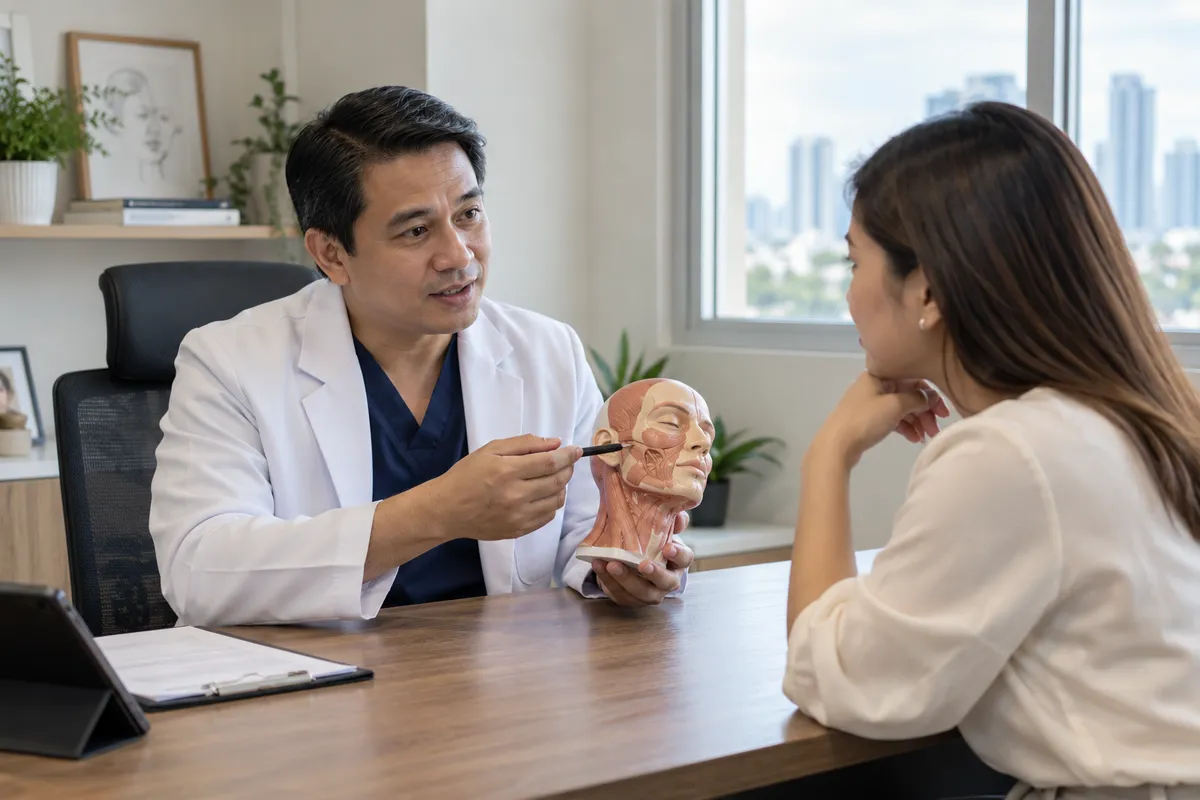
Listen for clear answers about goals, risks, alternatives, and aftercare.

Compare breast implant removal and revision goals, records, and aftercare.
