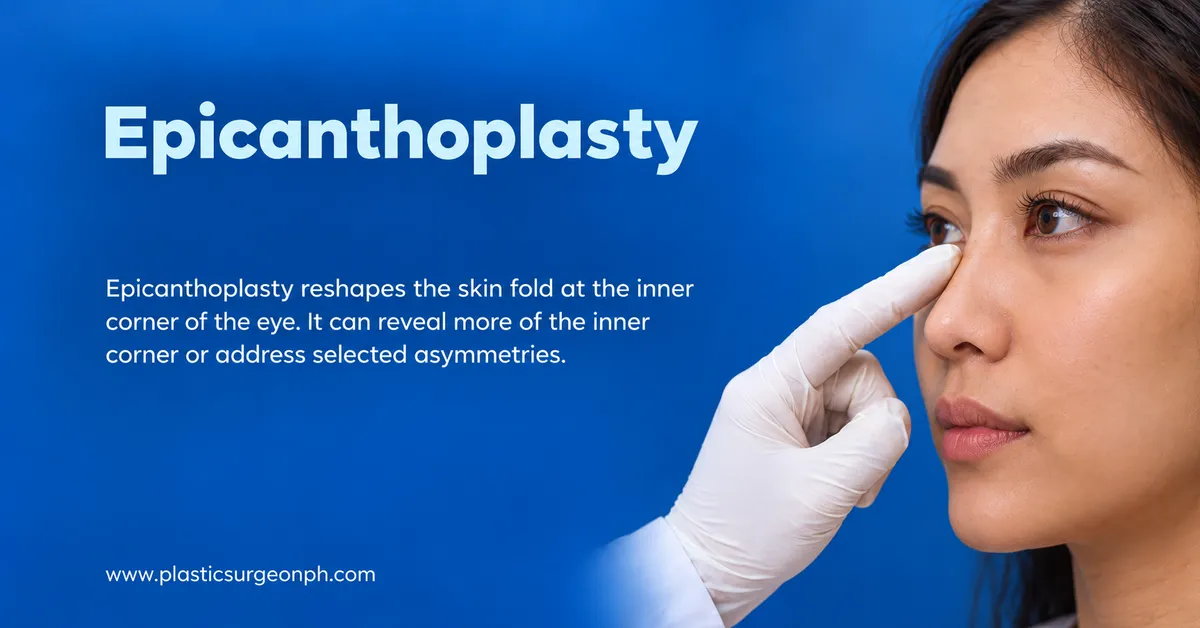
Epicanthoplasty is a highly individualised procedure that reshapes the epicanthal fold at the inner corner of the eye. Sound planning considers function, facial balance, skin and bone anatomy, healing tendency, and the patient’s own identity. This guide explains the operation in practical language for Philippine patients. It cannot replace an examination or a personalised quotation from the operating team.
What is Epicanthoplasty, and what concerns does it address?
An epicanthal fold is a normal feature that partly covers the inner canthus, where the upper and lower lids meet near the nose. Surgery can reveal more of the inner corner, reduce a webbed appearance, improve symmetry, or complement a double-eyelid crease. The goal should be proportionate exposure, not removal of every trace of the fold.
Medial epicanthoplasty addresses the inner corner. Less commonly, a reverse epicanthoplasty rebuilds tissue after overcorrection. Designs include Z-plasty, W-plasty, skin redraping, modified Mustarde methods, and minimal-incision releases. Each rearranges skin tension differently, so the scar and tendency to recur also differ. For patients whose main goal is an upper-lid crease, double eyelid surgery addresses that different feature. The upper- and lower-eyelid surgery comparison can help you separate questions about the upper and lower lids before consultation.
Who is a good candidate for Epicanthoplasty, and who is not?
Good candidates include patients with a prominent fold, inner-corner webbing, meaningful asymmetry, or a crease design that cannot be achieved naturally without releasing the fold. They should be in reasonably good health, have stable and specific goals, understand the limitations, and be able to follow recovery instructions. A consultation should explore what the patient hopes will change and what must remain natural or functional.
Surgery should be postponed or reconsidered for patients seeking an extreme exposed inner corner, those prone to troublesome raised scars, people with active eyelid inflammation, or anyone who has not accepted that a visible scar is possible. Pregnancy, active infection, uncontrolled diabetes or blood pressure, bleeding disorders, and nicotine exposure may also increase risk. A careful surgeon may request treatment, medical clearance, or a period of observation before deciding that an elective operation is appropriate.
What are the different types or techniques used in Epicanthoplasty?
A conservative skin-redraping technique may release underlying tension without removing much skin. Z-plasty and related local flaps change the direction of the fold and distribute tension. The design must respect the lacrimal drainage structures and avoid an unnaturally sharp, overexposed lacrimal lake. It may be performed alone or with Asian blepharoplasty.
The most fashionable technique is not automatically the best one. The correct approach depends on examination findings, prior surgery, tissue quality, desired change, and the surgeon’s ability to protect nearby nerves, vessels, muscles, and sensory structures. Ask why a method suits your anatomy, what trade-offs it creates, and what revision options would remain.
Are there non-surgical alternatives to Epicanthoplasty?
Possible alternatives include make-up can create an optical impression of a longer eye, but fillers, threads, laser, and skin-tightening devices cannot safely release a true epicanthal fold. Non-surgical treatment is generally temporary or limited in the size of change it can create. It may be sensible for a subtle concern or for someone who is not ready for surgery, but it should not be presented as equivalent when the problem is structural. Injectables also have real risks and require a qualified physician.
How do I prepare for Epicanthoplasty?
Preparation starts with careful scar-history review, dry-eye screening when indicated, and frontal photographs showing how the fold interacts with the planned upper-lid crease. Give a complete list of prescription medicines, over-the-counter drugs, vitamins, herbal products, allergies, prior procedures, and any reaction to anesthesia. The surgeon may request blood tests, imaging, medical clearance, or specialist review according to the operation and your health.
Stop smoking, vaping, and all nicotine for the period directed because nicotine narrows blood vessels and impairs healing. Do not stop aspirin, anticoagulants, or other prescribed medicines on your own. Follow written instructions on fasting, skin or hair washing, and medicines to take on the day. Arrange an adult escort, safe transport, and help at home. Prepare soft food if advised and keep the recovery space cool, clean, and easy to use.
How is Epicanthoplasty performed, and how long does it take?
The surgeon marks a small flap pattern at the inner corner, injects local anesthetic, releases restrictive tissue, and rearranges the skin without excessive excision. Very fine sutures close the wound under minimal tension. The lacrimal puncta and canaliculi, which drain tears, are protected throughout.
Operating time is usually about 45 to 90 minutes, or longer when combined with double-eyelid surgery. Complex anatomy, revision surgery, several combined procedures, or the need to reassess symmetry can lengthen this. Time in the facility also includes admission, marking, anesthesia, recovery-room monitoring, and discharge checks, so the entire visit is longer than the operation itself.
What type of anesthesia is used, and who administers it?
Typical options are local anesthesia with or without light sedation; selected combined cases may use general anesthesia. The final plan depends on the extent of surgery, age, health, airway, and the facility. Sedation and general anesthesia should be administered and continuously monitored by a qualified anesthesiologist, not by an untrained assistant. Local anesthesia may be placed by the surgeon. Ask who will provide anesthesia, what monitoring will be used, and how emergencies are managed.
What results can I realistically expect, and when will I see them?
The eye opening may look longer and the inner corner less covered immediately, but early swelling can exaggerate exposure. The shape becomes more natural over six to twelve weeks, and scars may continue fading for a year.
The realistic aim is meaningful improvement and better proportion, not perfect symmetry, a copied celebrity feature, or a guaranteed emotional outcome. Photographs are useful for planning and follow-up, but digital simulations are communication tools rather than promises. Final judgement should wait until swelling and scar contraction have settled.
Will I have scars after Epicanthoplasty, and how visible will they be?
A short scar is placed at or beside the inner corner, where it cannot be hidden completely in a crease. It is often pink or firm early and usually softens, but patients with darker or scar-prone skin may notice it longer.
All incisions create permanent scars, even when they become faint. Early scars may be red, raised, numb, itchy, or firm before softening over 6 to 18 months. Scar quality depends on genetics, tension, infection, sun exposure, nicotine, and aftercare. Filipino skin tones can develop dark marks or raised scars, so use only surgeon-approved scar treatment and diligent sun protection.
What are the risks and possible complications of Epicanthoplasty?
General surgical risks include bleeding, hematoma, infection, fluid collection, delayed healing, unfavourable scarring, altered sensation, persistent pain, asymmetry, allergy, anesthetic problems, blood clots, and dissatisfaction. Procedure-specific concerns include visible or raised scarring, recurrent webbing, undercorrection, overexposure of the inner corner, asymmetry, an unnatural pointed shape, irritation, dry-eye symptoms, and rare injury to the tear-drainage system. Some complications settle with observation or medicine, while others require an urgent procedure or later revision.
Risk cannot be reduced to zero. It is lowered by honest medical screening, conservative planning, an appropriately trained surgeon, qualified anesthesia care, a licensed facility, and reliable follow-up. Seek urgent help for breathing difficulty, chest pain, sudden vision change, one-sided weakness, rapidly increasing swelling, heavy bleeding, high fever, severe unrelieved pain, or any symptom your team identifies as an emergency.
What is recovery like after Epicanthoplasty, and how long does it take?
Mild swelling, tearing, tightness, and bruising are common during the first week. Sutures are generally removed within five to seven days. Make-up and contact lenses remain off until the surgeon confirms that the surface is sealed.
Healing is not perfectly linear. One side may swell or settle faster, and sensations can change from day to day. Take only approved medicines, drink enough fluid, eat protein-rich food, avoid nicotine and alcohol as directed, and sleep in the recommended position. Most early healing occurs over two to four weeks, while deeper swelling, nerves, and scars may continue improving for several months.
When can I return to work, exercise, and normal activities?
A reasonable planning estimate is about seven to ten days, although scar redness can remain visible beyond that period before returning to work. Gentle walking immediately and ordinary household activity after several days is commonly acceptable. Strenuous exercise, heavy lifting, contact sport, and activities that sharply raise blood pressure usually wait three to four weeks, with longer protection from rubbing, swimming, and eye trauma. These are planning ranges, not clearance. Patients with a physically demanding job, a long commute, public-facing duties, or combined surgery often need more time.
What aftercare and follow-up appointments are required?
Expected follow-up includes a first-week visit for wound review and suture removal, followed by scar and symmetry assessments at one, three, six, and sometimes twelve months. Follow the written instructions for dressings, cleansing, showers, sleeping position, diet, compression, eye or mouth care, and prescribed medicine. Do not massage, apply heat, start scar products, remove tape, or resume supplements without approval. Keep the clinic’s daytime and after-hours contact details and attend reviews even when recovery seems straightforward.
How long do the results of Epicanthoplasty last?
The tissue rearrangement is intended to be permanent, although partial recurrence or scar contraction can change the inner-corner shape and ageing continues.
Long-lasting does not mean frozen in time. Ageing, weight change, sun exposure, illness, trauma, and tissue quality continue to affect the face. Protecting the skin, maintaining stable health, avoiding nicotine, and treating new functional problems early help preserve the result. Revision should be considered only after adequate healing unless there is an urgent complication.
How much does Epicanthoplasty cost in the Philippines, and what is included in the price?
For private care in the Philippines, a cautious planning range is about PHP 50,000 to PHP 150,000. This is an indicative 2026 market range, not a quotation, and unusual complexity or a premium hospital can cost more. The main price drivers are the technique, operating time, surgeon and anesthesiologist fees, facility level, implants or grafts, imaging, and whether the procedure is combined with another operation.
Ask for a written itemisation and confirm whether one or both sides are treated, whether blepharoplasty is included, and whether scar medicines, anesthesia, and scheduled reviews are separate. A complete quotation should state consultation, tests, professional fees, operating and recovery rooms, implants or consumables, medicines, garments or dressings, scheduled follow-up, and the policy for unexpected admission or revision. Verify the physician through the PRC and relevant specialist society. For this procedure, consultation with a plastic or oculoplastic surgeon with specific experience in Asian eyelid anatomy is appropriate. Purely cosmetic care is usually self-funded, while a documented functional component may be assessed separately by PhilHealth or a private insurer.
Thank you for sharing this article...
About the Author: Joan de Alta

View Surgeon Profiles




Explore Available Clinics



Browse Other Procedures

Tuberous breast correction reshapes breasts with a tight, constricted base.