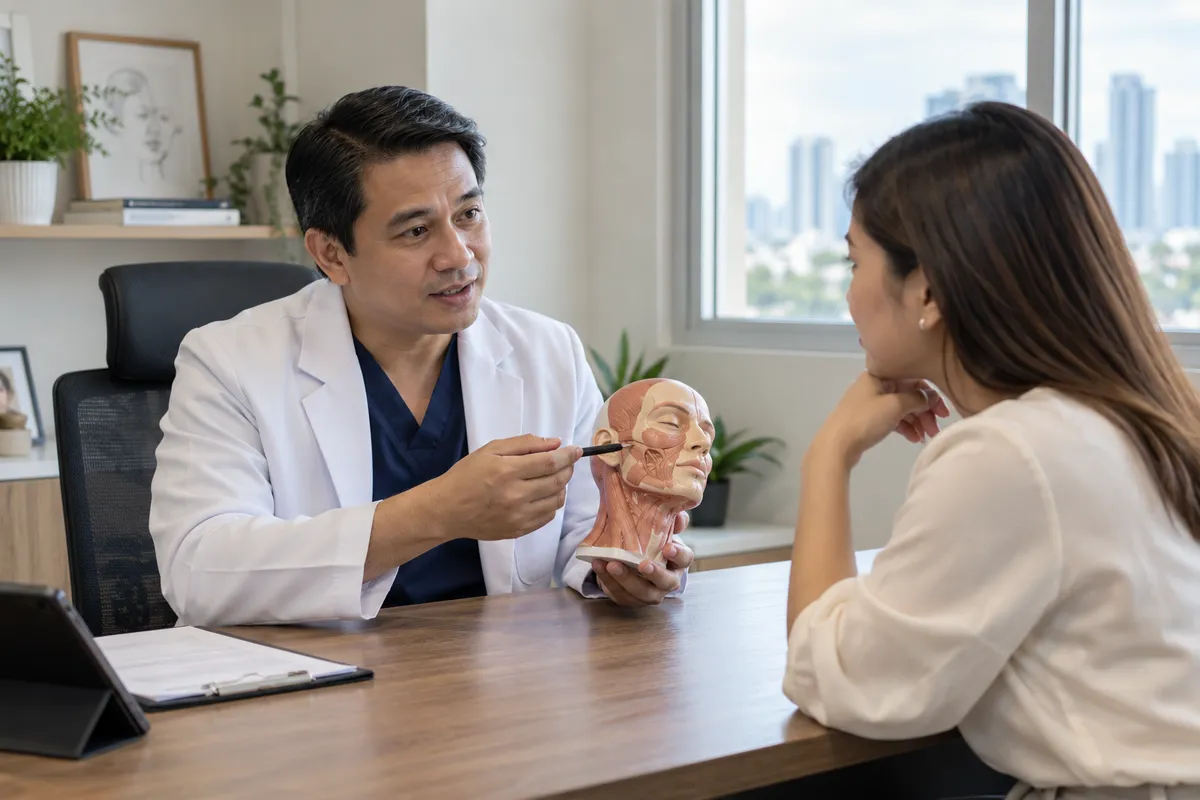
Quick answer: A plastic surgeon is a physician trained in the surgical specialty of plastic surgery, which includes both reconstructive and aesthetic work. “Cosmetic surgeon” generally describes a doctor whose practice focuses on improving appearance, but the label alone may not identify the doctor’s original specialty, residency training, board status, or experience with a particular operation. Some fully trained plastic surgeons also describe themselves as cosmetic surgeons. However, patients should never assume that every cosmetic surgeon has completed formal plastic surgery training.
The difference matters because choosing a surgeon is not simply about selecting the most appealing title. You need to know what the doctor trained in, which credentials can be independently verified, how often the doctor performs the proposed procedure, and where the surgery will take place. In the Philippines, these checks are especially important when advertisements, clinic pages, and social media profiles use similar terms for professionals with different backgrounds.
Why the Two Terms Are So Often Confused
Plastic surgery and cosmetic surgery overlap, but they are not exact synonyms. Plastic surgery is a broad surgical specialty. Cosmetic surgery describes the purpose of a treatment: changing or enhancing appearance. Because aesthetic procedures form part of plastic surgery, a plastic surgeon may perform cosmetic operations such as breast augmentation, rhinoplasty, eyelid surgery, liposuction, or a facelift.
At the same time, cosmetic care can also be offered by doctors whose primary training is in another field. Depending on the procedure and local rules, that background may include dermatology, otolaryngology, ophthalmology, oral and maxillofacial surgery, general surgery, or another area. Their qualifications may be appropriate for certain treatments, but the words “cosmetic surgeon” do not, by themselves, explain the full training path.
The American Society of Plastic Surgeons explains the international distinction by noting that plastic surgery covers both reconstructive and cosmetic care. Certification systems differ among countries, so Philippine patients should use that explanation as background rather than applying United States credentials directly to a local doctor.
What Is a Plastic Surgeon?
A plastic surgeon is a medical doctor who has completed formal specialty training in plastic surgery after medical school. That training is designed to develop surgical judgment, technical skill, knowledge of anatomy, wound management, reconstruction, complication care, and aesthetic principles. The specialty is not limited to elective beauty procedures.
Plastic surgeons may restore form or function after injury, burns, cancer treatment, infection, congenital differences, or other medical conditions. Their work may involve skin, soft tissue, bone, nerves, blood vessels, or multiple body areas. Examples include cleft care, hand surgery, wound coverage, scar reconstruction, breast reconstruction, and repair after trauma.
For instance, a patient considering breast reconstruction after cancer treatment may need coordination among a plastic surgeon, breast surgeon, oncologist, and other specialists. The aim may include restoring shape while also accounting for previous surgery, radiation, tissue quality, healing, and future medical care.
Plastic surgeons may also concentrate heavily on aesthetic procedures. A doctor can therefore be both a plastic surgeon by specialty training and a cosmetic surgeon by the focus of the practice. A breast augmentation consultation, for example, can involve aesthetic goals while still requiring careful surgical planning, implant discussions, risk assessment, and long-term follow-up.
What Is a Cosmetic Surgeon?
A cosmetic surgeon is a physician who performs procedures intended primarily to improve appearance. The term describes the goal of the work more clearly than it describes one uniform training route. That is why two doctors using the same title may have completed different residencies, fellowships, courses, examinations, and supervised surgical experience.
This does not mean that a doctor using the title is automatically unqualified. It means the title should be the beginning of your research, not the conclusion. Ask for the doctor’s original medical specialty, the exact name of any certifying board, the status of that certification, and the training completed for the procedure you are considering.
Patients should also separate surgery from nonsurgical aesthetic care. Injectables, lasers, peels, energy-based devices, and skin treatments have different skill requirements and risk profiles from operations performed in an operating room. If you are still comparing these options, the guide to surgery versus nonsurgical treatment can help you prepare more focused questions.
Plastic Surgeon vs. Cosmetic Surgeon: Key Differences

| Point of comparison | Plastic surgeon | Cosmetic surgeon |
|---|---|---|
| Meaning of the title | Identifies formal training in the specialty of plastic surgery. | Usually identifies a practice focus on appearance-enhancing procedures. |
| Typical scope | May include reconstructive, functional, and aesthetic surgery. | Primarily includes aesthetic procedures and treatments. |
| Training information | The specialty pathway should include structured plastic surgery training. | The underlying specialty and cosmetic training may vary, so patients need to ask. |
| Procedures | May treat congenital differences, trauma, burns, cancer-related defects, wounds, and cosmetic concerns. | May offer surgical or nonsurgical procedures intended to change appearance. |
| What patients should verify | License, specialty training, board status, procedure experience, facility, and care plan. | The same items, with particular attention to the doctor’s original specialty and procedure-specific training. |
The most important point is simple: a plastic surgeon may perform cosmetic surgery, but a doctor performing cosmetic surgery is not necessarily a plastic surgeon. Marketing language can blur that distinction. Independent verification gives you more useful information than a website headline, clinic package, celebrity endorsement, or follower count.
Is One Type of Surgeon Always Better?
No title can guarantee a good result, and no single credential replaces a proper consultation. However, the doctor’s training should match the complexity and risks of the proposed care. For a reconstructive operation, formal plastic surgery expertise may be central to the plan. For an elective aesthetic operation, relevant surgical training, current credentials, experience with that exact procedure, safe facilities, and reliable follow-up all matter.
A doctor may be highly experienced in one operation but perform another only occasionally. Similarly, someone who produces attractive results for straightforward cases may not be the best match for revision surgery, complex anatomy, significant medical conditions, or a procedure that affects both appearance and function.
Therefore, avoid asking only, “Are you a cosmetic surgeon?” A more useful question is, “What formal specialty training and supervised experience prepared you to perform this particular procedure, and how will you manage a complication if one occurs?” The answer should be specific, understandable, and open to verification.
How to Verify a Surgeon in the Philippines
1. Confirm the Doctor’s Exact Name and Professional License
Ask for the physician’s complete registered name and professional license details. Then use the Professional Regulation Commission’s online verification service to check the available record. A clinic nickname, shortened surname, or social media handle may not be enough to identify the correct professional.
A valid physician license is an essential starting point, but it does not tell you every specialty qualification or how much experience the doctor has with your procedure. Continue with the remaining checks rather than treating license verification as a complete review.
2. Check Specialty Training and Board Status
Ask which residency program the doctor completed, where it was completed, and what specialty board issued any claimed certification. “Board-certified” is incomplete unless the doctor names the board and the specialty. You can also consult the PAPRAS doctor directory and confirm the category or status shown for the physician.
Use the doctor’s full name consistently across all sources. If details differ, ask the clinic to explain the discrepancy in writing. PlasticSurgeonPH’s guide on how to verify cosmetic surgeon credentials provides a practical sequence for checking claims without relying on popularity alone.
3. Ask About Experience With Your Exact Procedure
Years in practice do not automatically equal extensive experience with every operation. Ask how often the surgeon performs the procedure, which types of cases are most common, and whether the doctor regularly treats patients with anatomy or medical concerns similar to yours.
When viewing before-and-after photographs, ask whether the images show the doctor’s own patients, whether the lighting and angles are consistent, and how long after surgery the “after” images were taken. Photos can support a discussion, but they cannot predict your result.
4. Verify the Facility, Anesthesia Plan, and Care Team
Find out exactly where the procedure will occur and whether the facility is appropriately licensed or accredited for the planned surgery. Ask who will administer anesthesia, who will assist, who will monitor you during recovery, and where you would be transferred if a higher level of care became necessary.
The surgeon’s credentials and the facility’s safety arrangements are related but separate issues. A qualified doctor still needs an appropriate setting, trained staff, working equipment, infection-control processes, medicines, monitoring, and an emergency plan.
5. Evaluate the Consultation, Not Just the Sales Presentation
A good consultation should include your goals, medical history, medicines, allergies, previous procedures, examination findings, alternatives, limitations, risks, recovery, and follow-up. The doctor should explain why the recommended approach fits you rather than presenting one package as suitable for everyone.
Bring a written list of questions. The first cosmetic surgery consultation checklist can help you organize your priorities before the appointment. If essential questions are redirected only to a salesperson, request time with the treating surgeon.
6. Understand Who Manages Complications and Follow-Up
Ask who is responsible after office hours, where follow-up visits will happen, and what the clinic expects you to do if symptoms change. Learn whether the proposed fee includes routine follow-up and how the team handles an unplanned return to the operating room, hospital assessment, or revision discussion.
Do not accept vague reassurance such as “nothing will go wrong.” Every procedure has limits and potential complications. A trustworthy clinician should be willing to explain likely risks, uncommon serious risks, prevention steps, and the response plan without pressuring you to book immediately.
Warning Signs That Deserve a Pause

- The clinic will not provide the treating doctor’s complete registered name.
- Credentials are described with impressive abbreviations that cannot be clearly explained or independently checked.
- The consultation focuses on discounts, deposits, or limited-time offers before your health history is reviewed.
- The person recommending surgery is not the surgeon who will perform it.
- The facility, anesthesia provider, or emergency arrangements remain unclear.
- The doctor guarantees a specific result or dismisses reasonable questions about complications.
- You are discouraged from seeking a second opinion or taking time to decide.
One unclear answer may be a misunderstanding, but several unresolved issues are a reason to stop. Review these cosmetic surgery consultation red flags before paying a deposit or signing consent documents.
Questions to Ask Any Surgeon You Are Considering
- What is your complete medical specialty and where did you complete your residency?
- Which board certified you, and how can I verify your current status?
- How often do you perform this exact procedure?
- Who will perform each part of my treatment and administer anesthesia?
- Where will the procedure take place, and what licenses or accreditations apply?
- What alternatives should I consider, including no treatment?
- What risks are most relevant to my health and anatomy?
- Who will manage my follow-up and respond after hours?
- What costs are included, and what possible costs are not included?
- What would make you postpone, modify, or decline the procedure?
You can also compare the care setting using the guide to questions every surgery clinic should answer. A strong surgeon-clinic combination should provide consistent information rather than conflicting explanations from the doctor, coordinator, and billing staff.
The Bottom Line
The difference between a plastic surgeon and a cosmetic surgeon is mainly about specialty training versus practice focus. Plastic surgeons receive formal training across reconstructive and aesthetic surgery. Cosmetic surgeons focus on appearance-enhancing care, but their original specialties and training routes may differ. A plastic surgeon can therefore be a cosmetic surgeon, while the reverse is not automatically true.
Choose based on verifiable qualifications, relevant experience, clear communication, an appropriate facility, and a dependable follow-up plan. Do not let the title alone make the decision. Take time to check the doctor’s full professional record and ask how the training applies to your exact procedure.
This article provides general educational information and is not a substitute for individualized medical advice, diagnosis, or treatment. A qualified clinician must assess whether any procedure is appropriate for you.
Frequently Asked Questions
Can a plastic surgeon also provide nonsurgical cosmetic treatments?
Yes. Some plastic surgeons offer injectables, skin treatments, lasers, and other nonsurgical services in addition to operations. Ask who will personally perform the treatment, what product or device will be used, and what training that person has for the service.
Will health insurance cover treatment by a plastic surgeon?
Coverage generally depends on the medical reason for treatment, the terms of the insurance plan, required documentation, and the provider or facility. A reconstructive procedure may be considered differently from a purely elective cosmetic procedure. Confirm coverage directly with the insurer before treatment.
Does a verified social media account prove that a surgeon is qualified?
No. A platform verification badge usually confirms account identity or subscription status, not a medical license, specialty training, board certification, procedure experience, or facility standards. Check professional credentials through appropriate official sources.
Should I choose a surgeon close to my home?
Convenient access can make consultations and follow-up easier, especially if several visits are needed. However, location should not replace relevant qualifications, procedure experience, facility safety, and a clear plan for urgent concerns. Balance travel demands with the quality and continuity of care.
What documents should I request after a surgical consultation?
Ask for the proposed procedure name, an itemized quotation, preoperative requirements, consent information, recovery instructions, follow-up schedule, and contact details for urgent concerns. Review the documents before paying a deposit or agreeing to a date.
Thank you for sharing this article...
About the Author: Randy Alta