
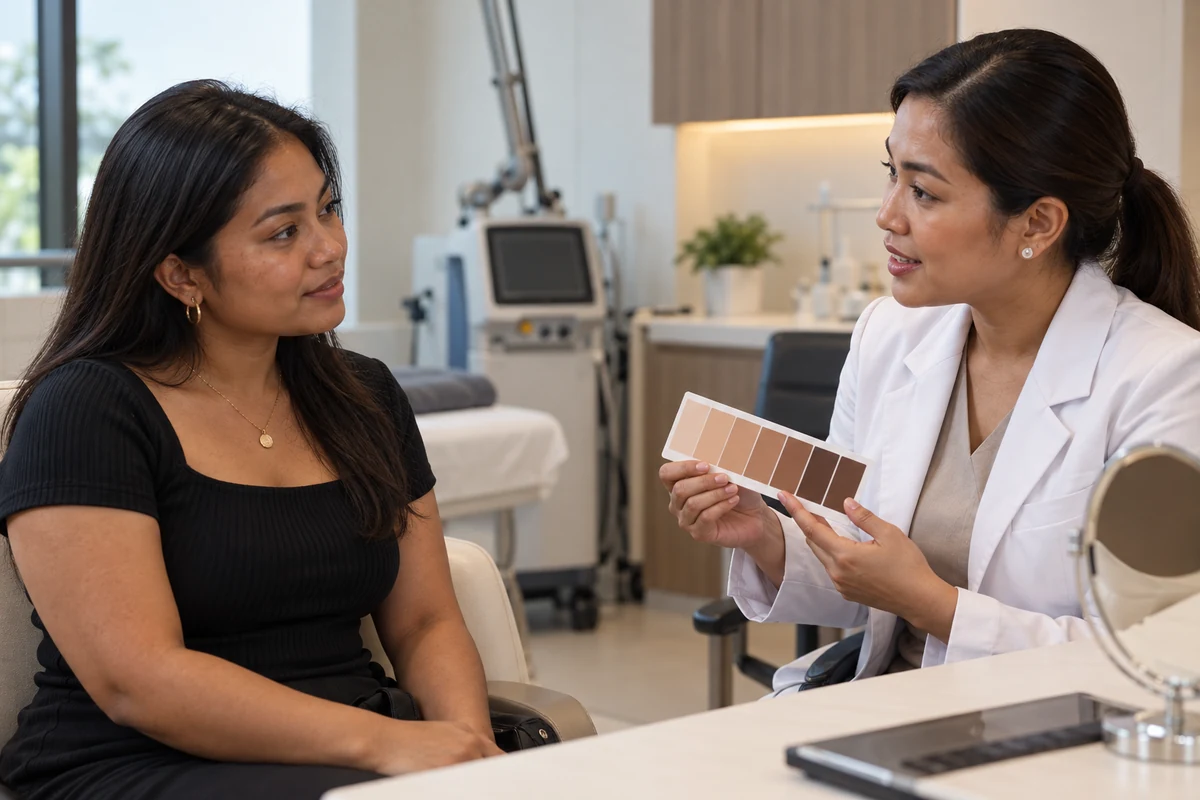
Laser treatment for dark skin requires an assessment of the concern, previous skin responses, proposed device and clinician’s relevant experience. A useful consultation explains why a particular approach is being considered, what risks matter to you, and whether another option or no treatment is preferable.
This distinction is important for Filipino patients, whose skin tones and treatment histories vary widely. Nationality alone cannot determine a device or treatment setting. This guide focuses on questions to ask before buying a session or package. It does not recommend a laser wavelength, energy level, bleaching regimen, or procedure for an individual reader.
Laser treatment for dark skin: Start with a diagnosis or clearly defined treatment goal
Explain the concern in ordinary language: unwanted hair, a change in pigmentation, a visible scar, or texture that you want assessed. These are different problems. A device advertised for several purposes does not establish that the same protocol or provider is appropriate for all of them.
Ask what the clinician thinks is causing the concern and whether additional assessment is needed before treatment. A new or changing skin mark should not automatically be treated as a cosmetic spot. The proposed intervention needs to follow an appropriate assessment rather than a receptionist’s selection from a promotional menu.
The laser clinic questions guide provides a general starting point. For darker skin, go further by asking how your own pigment response, treatment history, and daily sun exposure affect the recommendation. These details can change the discussion even when two patients request the same service.
Understand what the device is meant to target
Laser hair removal, resurfacing, and treatment of selected pigment concerns have different aims. Ask for the exact proposed treatment and device rather than accepting “latest laser” as an explanation. You should understand what is being targeted, the expected course, and which part of your concern the procedure will not address.
The American Academy of Dermatology explains that laser hair removal can be an option for darker skin when carefully performed by an appropriately skilled clinician. That should not be generalized into a claim that every device is suitable or that experience with one laser procedure proves competence in another.
Similarly, an established device name is not a guarantee of an appropriate plan. Ask how the clinician selects the technology and modifies the approach for the patient. The answer should concern assessment and clinical reasoning, not simply how new, imported, expensive, or exclusive the machine is.
If a clinic will not identify the device or explain the proposed purpose, pause before purchasing a package. The site’s guide to evaluating device claims can help you distinguish a marketing feature from information that supports a treatment decision.
Discuss pigment changes without assuming all darker skin is alike
Tell the clinician how your skin has responded to acne, cuts, burns, sun exposure, and previous treatments. A history of long-lasting dark marks, lighter patches, or a difficult recovery is relevant. Use examples from your own experience rather than trying to assign yourself a skin category from an online photograph.
Hyperpigmentation means increased pigmentation, while hypopigmentation means reduced pigmentation. These are descriptions, not complete diagnoses. Burns, scarring, and lasting color changes are possible risks of some laser treatments. Ask which risks are important for the actual procedure and how the clinician assesses and manages them.
The ASPS discussion of resurfacing candidacy highlights pigmentation concerns in darker skin. This does not make every darker-skinned patient unsuitable for every laser treatment. It reinforces the need to distinguish the procedure, the person’s skin, and the provider’s relevant expertise.
A responsible explanation should avoid both blanket reassurance and blanket exclusion based on ethnicity. Ask the clinician to explain what features of your assessment matter. If the proposal is unclear, a dermatologist or another appropriately qualified specialist may help clarify the options before you commit. Discuss laser treatment for dark skin using your own history of pigment changes and scarring rather than an assumption based on ethnicity alone.
Check experience with patients and concerns similar to yours
Ask who will assess you, who will operate the device, and what supervision is provided. These may not be the same person. Verify the clinician’s exact identity and relevant training, and ask about experience with the proposed treatment in skin that responds similarly to yours.
The credential verification article explains why a popular account or professional-looking profile is not enough. For laser treatment, qualifications should also connect to the actual procedure and the setting in which it is offered. A general title does not explain who will make clinical decisions during your visit.
Ask how the clinic responds to an unexpected reaction and who provides a medical review. A promise that complications never happen is less useful than a clear plan for recognizing and managing a concern. You should know the contact route before a problem occurs, including outside normal business hours.
Share the details that can change the plan
Bring a list of medicines, topical products, supplements, and recent treatments. Explain any recent tanning, skin irritation, infection, or change in your usual routine. Include treatments obtained elsewhere, even if they seemed mild or were described as a facial rather than a medical procedure.
Do not independently stop a prescribed product or medicine to qualify for an appointment. Ask the responsible clinician to explain any change, its timing, and who should coordinate with your usual prescriber. The appropriate instructions depend on what you use and why, not just the name of a procedure.
Also discuss your work and travel. If avoiding exposure or following the proposed aftercare would be difficult, say so before paying. A plan that assumes you remain indoors may not fit a delivery rider, outdoor worker, or someone facing repeated transport transfers. Scheduling is part of the clinical conversation when it affects the ability to follow instructions.
Ask what a test area can and cannot establish
Some clinicians may propose a test area as part of planning. Ask why it is being considered, how it will be reviewed, and what information would change the larger treatment. A test is not simply a ceremonial step that allows a clinic to advertise that every later session is guaranteed safe.
Clarify when you should return for review and what to report in the meantime. Do not assume that an immediate appearance tells the whole story. The clinician should explain the relevant observation period and how the findings relate to the proposed procedure, rather than expecting you to interpret a skin reaction alone.
If a test area is not proposed, ask how the clinician has reached the recommendation. There is no universal instruction here that every patient must demand an identical test. The purpose is to understand the reasoning and limits of the assessment, not replace it with a checklist that ignores the specific technology.
Compare alternatives and realistic endpoints
Ask what would count as a meaningful improvement for your concern. The answer may involve a partial change, repeated sessions, maintenance, or a decision that a different treatment is preferable. A guarantee of perfectly even skin or complete removal of every mark should prompt further questions.
The treatment comparison guide can help you compare purpose, limitations, cost, and follow-up. Avoid ranking options only by how dramatic the technology sounds. The alternative might be another procedure, a medical treatment plan, observation, or no intervention.
When reviewing example photographs, ask whether the lighting, timing, and complete treatment history are clear. Someone’s result may reflect several procedures or ongoing skin care. Use the before-and-after photo guide to keep a gallery from being mistaken for a personal prediction.
Confirm aftercare and the full course of costs
Ask which skin care products and activities need to change, when you can resume them, and who can clarify instructions. Instructions for another patient’s hair removal session are not interchangeable with those for your resurfacing procedure. Request the version that applies to your actual treatment area and skin history.
If you already have pigmentation concerns, the AAD’s guidance on darker skin and dark spots explains why identifying the cause and preventing further irritation matter. Do not respond to a post-treatment color change by adding multiple fading products without assessment.
Finally, obtain the session estimate, review arrangements, product charges, and cancellation terms in writing. Ask what happens if treatment is paused or the plan changes. Paying for a course should not mean continuing when a clinician needs to reassess the skin or when you no longer want the service.
Questions worth taking to the appointment
- What is the concern being treated, and how was it assessed?
- Why is this device and approach being considered for my skin?
- Who performs treatment and who manages an unexpected reaction?
- How do my previous pigment changes affect the risk discussion?
- What alternatives and realistic endpoints should I understand?
- What are the review plan, aftercare requirements, and complete costs?
The most useful consultation makes the treatment understandable and gives you room to decline it. Skin tone deserves thoughtful assessment, not a stereotype or a sales guarantee.
Frequently asked questions about laser treatment for dark skin
Can I bring my own sunglasses instead of using the clinic’s protective eyewear?
No. Ordinary sunglasses are not a substitute for the protective equipment selected for a particular laser. Tell the clinic if prescribed eyewear is uncomfortable or does not fit, and ask the responsible clinician to address that before treatment begins.
Should a package agreement explain what happens if the usual operator leaves?
Ask for the clinic’s policy in writing. Clarify whether a replacement professional will assess you, how records are transferred internally, and what choices you have if you do not accept the change. Do not assume a prepaid package guarantees access to one named practitioner.
Can I request a copy of my treatment record for another clinician?
Yes. Ask the clinic about its request process, identification requirements, format, and any applicable fee. A useful record can support continuity, but the receiving clinician should identify which details are needed and interpret them as part of a new assessment.
Can I ask that consultation discussions take place without a sales representative present?
Yes. Explain that you want to discuss clinical questions privately with the responsible professional. Ask which parts of the visit involve clinical assessment and which concern commercial arrangements. You should be able to understand the medical recommendation without treating a sales discussion as medical advice.
Thank you for sharing this article...
About the Author: Joan de Alta





Read Related Blog Posts

Plan for liposuction drainage with clear instructions and follow-up care.

Rhinoplasty Before-and-After Photos: How to Make a Fair Comparison
Compare upper and lower eyelid surgery by goals, risks, and recovery needs.
